SCDO Laboratory · TECH PR
UNIT 02
Series · Automated Contract Ledgers for AI Agents · Next-Gen Smart Payments
Web3 Primer: The Internet Agents Need
From accounts to wallets — next-gen app coordinates · Author Ying Willam Zhang
2. Web3
SCDO Lab · Web3 Primer for Newcomers v2 · English illustrated edition
Full bilingual book: Chinese/learn/web3/· English/learn/web3/en/
Chapter 1 covered Bitcoin as one digital-cash system. This chapter zooms out: what people mean by Web3, how it differs from everyday apps, what actually ships in 2026, and how a newcomer can start safely.
Not investment advice. Not a hype manifesto.
Opening: turn the foam down
Talk about Web3 and you usually hear three voices:
- Cure-all: it will replace Big Tech, banks, and governments—tomorrow.
- All scam: anything with a chain or a token is a rug.
- Jargon maze: DAO, DApp, TVL, account abstraction… three minutes and people close the tab.
We pick a fourth: engineering and product.
Web3 is not a company and not a single chain. It is an attempt to use blockchains + cryptographic keys + open protocols so that parts of the internet move from “you must trust this platform” toward “rules are public and critical actions are verifiable.” What already works is concrete; what is oversold is also concrete. After this chapter you should tell them apart.
Naming note: people mix Web3 and Web 3.0. Early texts said Web 3.0; spoken English today usually says Web3. We use Web3 below. It is not the older “Semantic Web 3.0” idea—if someone says 3.0, ask which lineage they mean.
What is Web3, really?
One-sentence version
Web3 ≈ using blockchain and related tech so users can hold digital assets and credentials themselves, and use online apps with less dependence on a single platform that “has the final say.”
Shorter: less “trust this company,” more “you can check.”
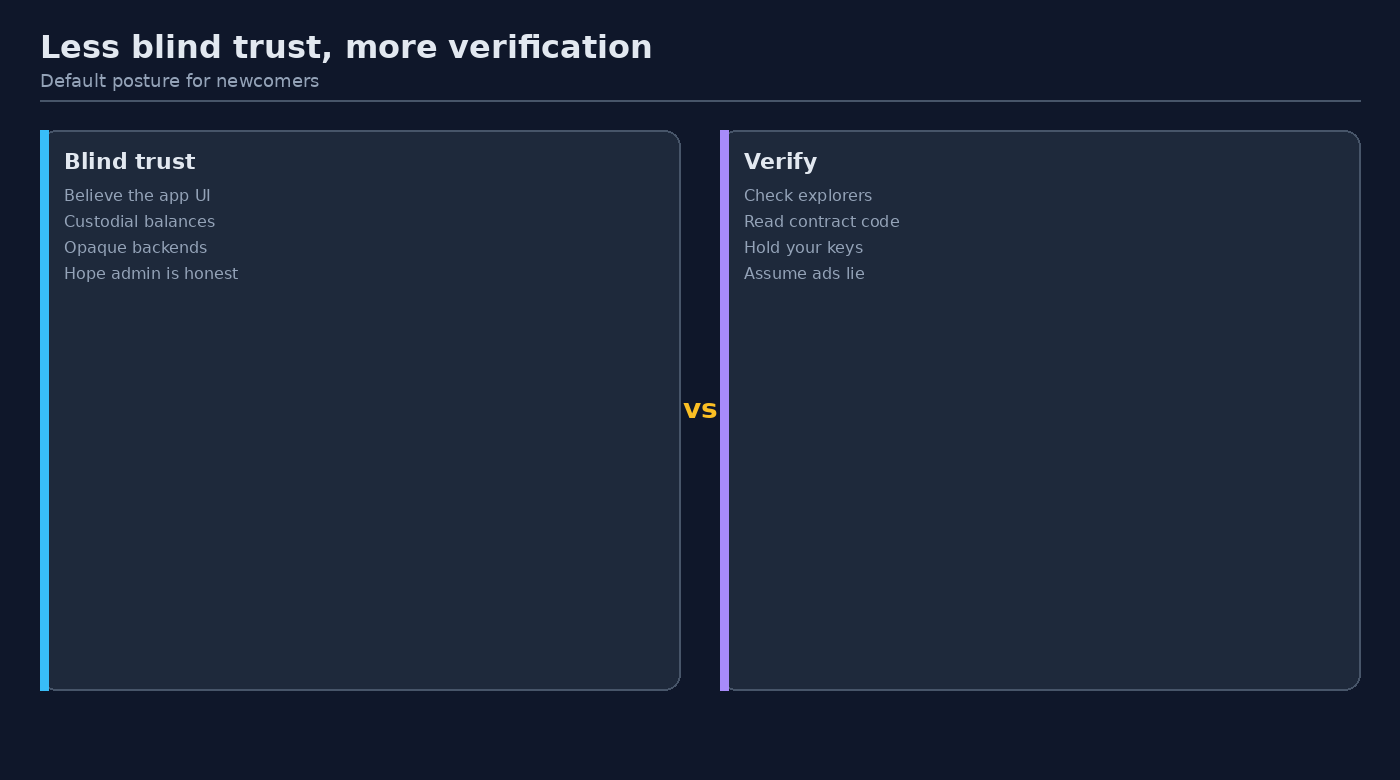
This direction was articulated in the mid-2010s by people around early Ethereum (long interview reprints from the old manuscript are not copied here). The point is engineering: reduce blind trust in authorities; bake verifiability into protocols. We agree with the direction—and must add a 2026 reality check: eliminating every intermediary does not exist. Exchanges, browsers, phone OSes, DNS, and stablecoin issuers are still intermediaries. Web3 changes which slice need not trust a single ledger-keeper; it does not put you in a vacuum.
Why bother?
Mainstream internet (Web2) is extremely useful: social, shopping, payments, video—a few giants cover most of daily life. The pain sits on top of that convenience:
- Accounts live elsewhere: bans, rule changes, opaque ranking—you leave or accept; taking data with you is hard.
- Money and points live elsewhere: skins, balances, creator payouts can vanish if a service shuts down or rewrites terms.
- High trust, thin evidence: you believe “the backend will honor the blog post”; individuals rarely audit the database.
Web3 aims at ownership and control—signatures prove “I authorized this”; public ledgers prove “this state update happened.” That is not automatically a fair society; it is one more technical option.
Less blind trust, more verification
“Trust” here is a systems word, not advice to distrust friends:
You must assume a black box is honest, always online, and will not rewrite the rules—without independent evidence.
Bitcoin transfers: the network can check double-spends.
Smart-contract swaps: you (or tools you trust) can read code and on-chain results, not only marketing copy.
If your coins sit on a centralized exchange, you are back to “trust that company’s ledger.” The tool can be Web3 while the habit stays Web2. Newcomers often miss that.
Can it break monopolies?
Vision decks love “break Big Tech lock-in.” Honest answer: weaken lock-in in places; overnight overthrow is unlikely.
- Cryptography lets ordinary people encrypt and self-custody—harder for a platform to unilaterally erase on-chain balances (custody and legal process are separate).
- Traffic, fiat on/off-ramps, app stores, and licenses remain highly centralized.
- Many “Web3 apps” are still ordinary websites: seize the domain or kill the API and UX dies.
A saner goal: critical assets and identity should not live only in one company’s database. Companies can still ship great UI without unilaterally wiping your on-chain rights.
What does decentralization mean?
We use a checkable definition:
Is there a single point that can halt the system, rewrite history, or move your assets without your consent?
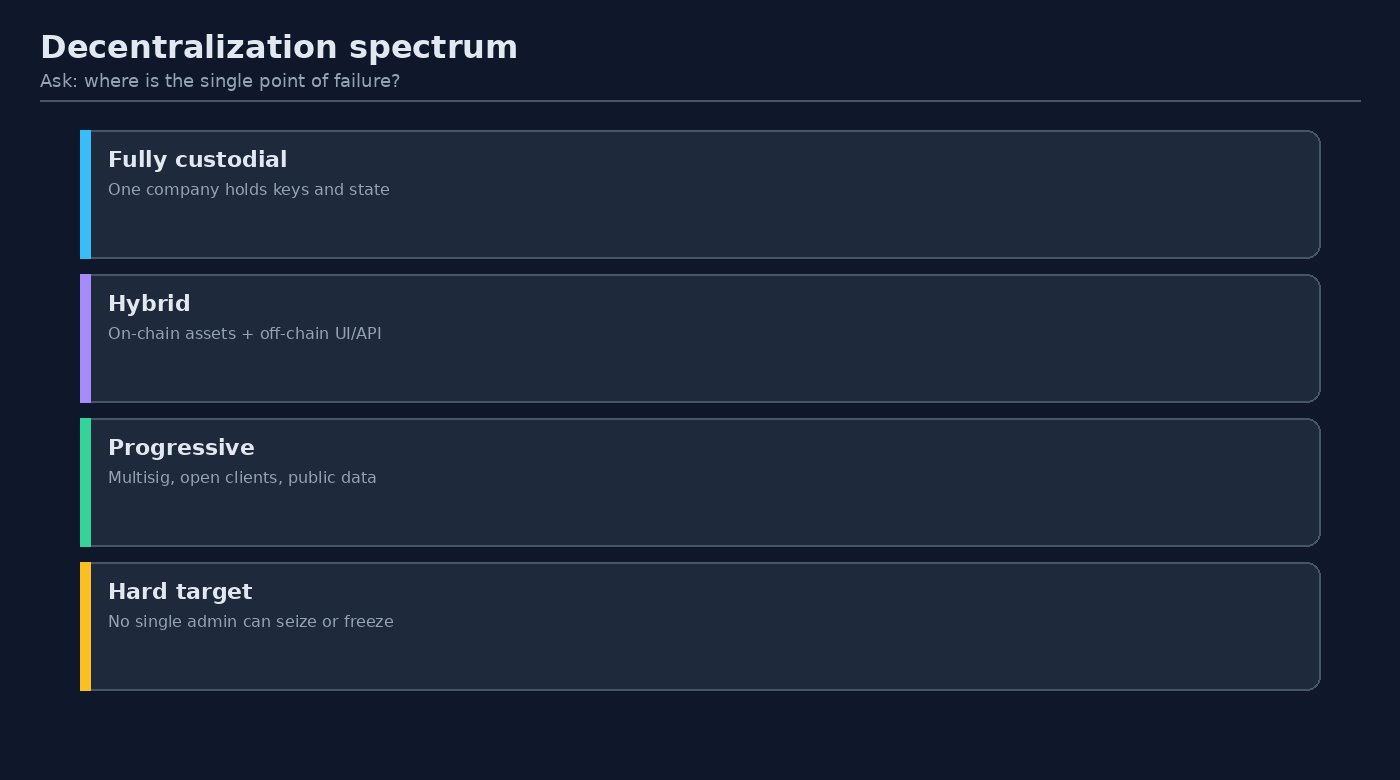
- Fully decentralized: almost never exists in pure form.
- Decentralized enough: attacks/failures are expensive; alternatives exist; users can run nodes or switch wallets.
- Decentralization theater: tokens are on-chain, but upgrades, sequencers, bridges, and oracles are a small club—look closely.
Decentralization ≠ lawlessness. Compliance, tax, and fraud rules still apply in most jurisdictions. Read it as reducing single-party domination in tech, not as a free-fire zone.
What does the Web3 world look like in 2026? (no moon math)
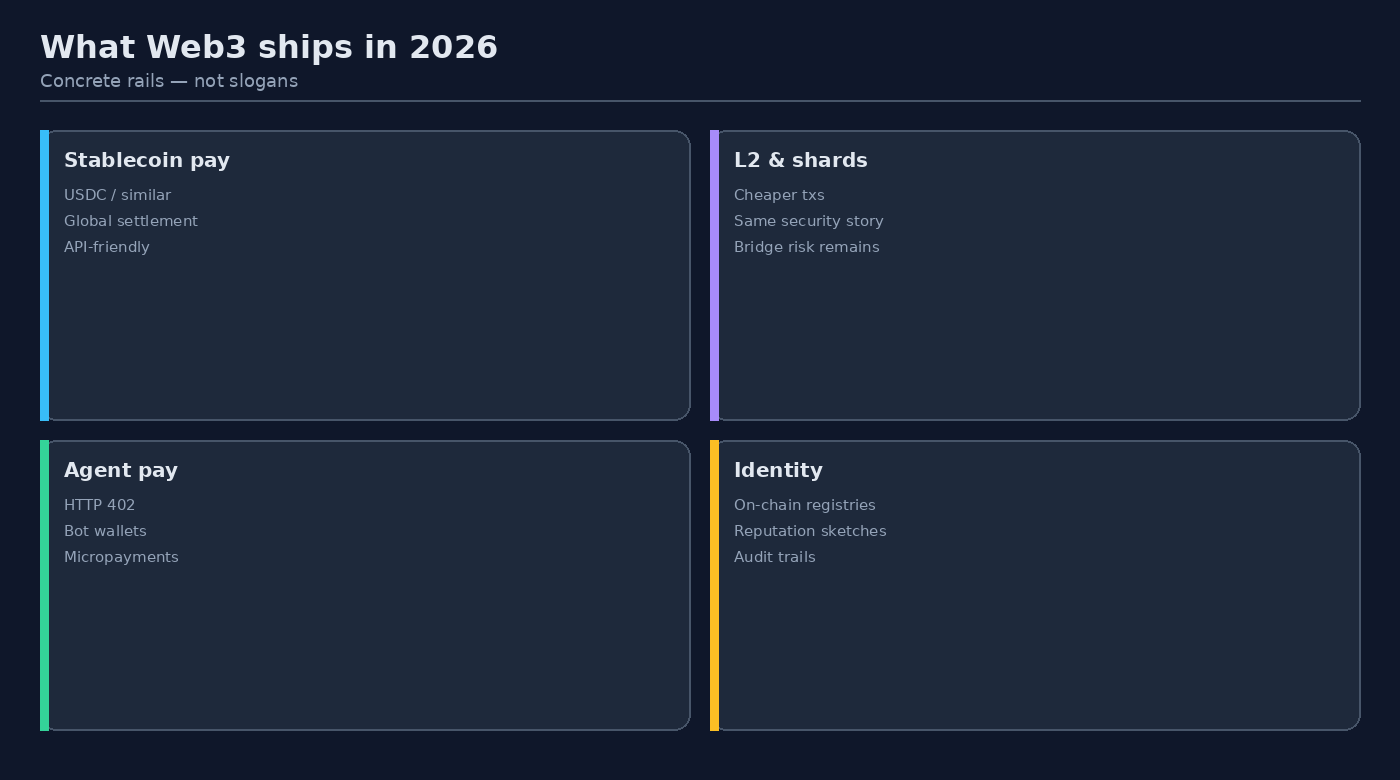
You can already touch:
| Layer | What you may meet |
|---|---|
| Assets | BTC, ETH, stablecoins, many tokens; some people access via exchanges or (in some markets) ETFs |
| Apps | DeFi swap/lend, NFT credentials, game items, on-chain social protocols |
| Gateways | Browser/mobile wallets, exchange apps, growing smart wallets / account abstraction |
| Infrastructure | Public chains, Layer 2s, bridges, oracles, indexers |
Still hard or unfinished:
- Mass-market UX with almost no seed-phrase learning curve (improving, not done);
- Seamless multi-chain without bridge risk;
- Replacing super-app social and payments habits wholesale with on-chain apps.
Honest 2026 takeaway: Web3 moved from “only miners and geeks” to “real financial and credential infrastructure,” but it has not fully replaced Web2. Treat it as an incremental toolbox, not a religion.
Common myths (clear the mines first)
-
“On-chain = decentralized and safe.”
Contracts can have upgrade backdoors; bridges can be multisigs; frontends can phish. A chain guarantees execution under current rules, not that rules favor you or that you clicked the real site. -
“Token + NFT = successful Web3 startup.”
Tokens coordinate incentives—or sell air. Real users, cash flow, or credential demand beat “we launched a coin.” -
“Decentralized apps ignore the law.”
Builders, issuers, fiat ramps, and marketing still meet finance and consumer rules in many places. Narrative ≠ compliance homework. -
“I installed a browser wallet, so I’m Web3.”
If funds sit on an exchange, you never open an explorer, and you approve every signature—habits are still Web2. Tools ≠ literacy. -
“AI + chain = money printer bot.”
In 2026, agents can call APIs and even pay; oversized permissions also steal and fail faster. Automation needs limits, allowlists, audit logs—why we talk about Agent Ledger: explain what the machine did before chasing speed.
How should ordinary people participate?
Old titles screamed “the wave is here.” We ask instead: if you are curious, how do you learn cheaply and safely?
Web1 → Web2 → Web3 in three lines
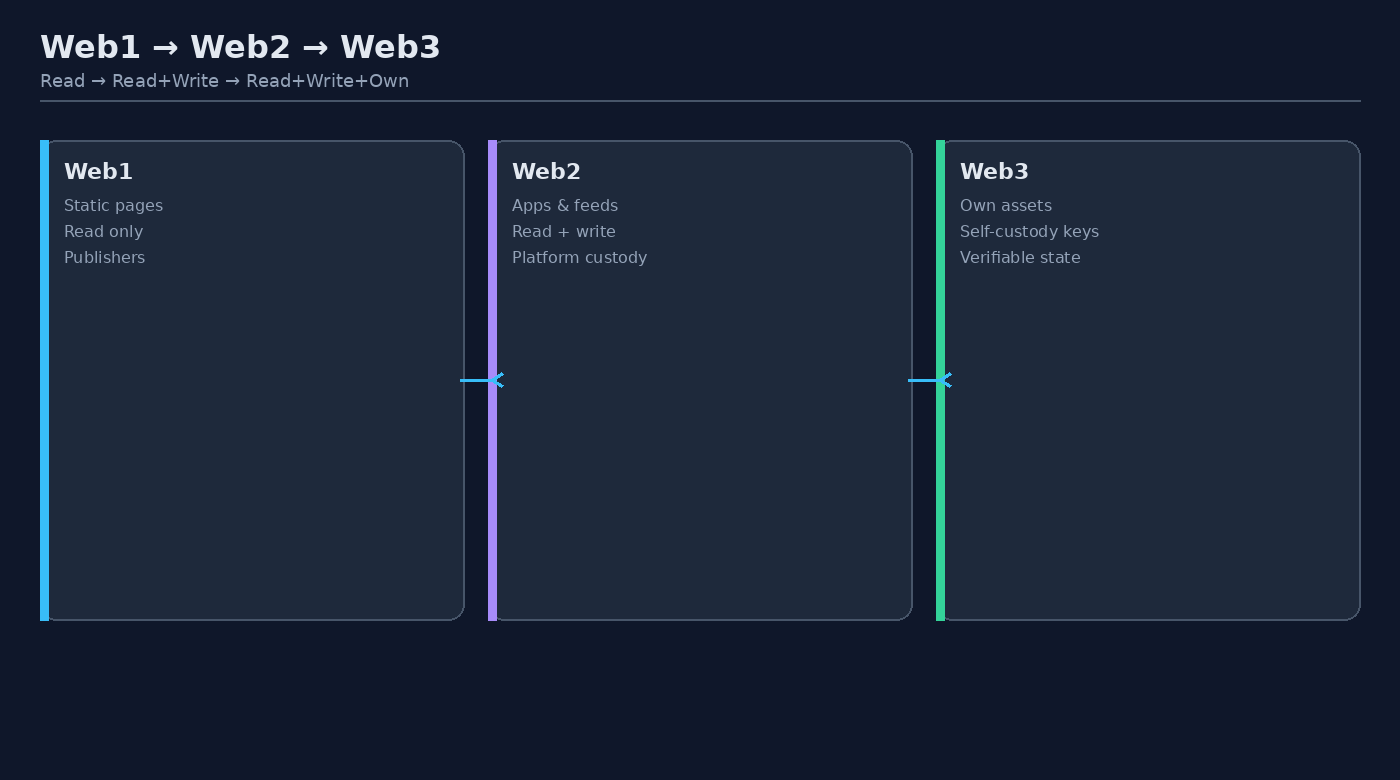
Skip the long timeline; remember the user role:
- Web1 (mostly read): portals and static pages—you are a reader.
- Web2 (read/write + platforms): you post and trade, but accounts, fans, data, and ranking live on platforms.
- Web3 (read/write + own): you still use apps, but key assets and some identity can be key-held; rules prefer protocols/contracts.
“User-controlled data/assets” is directionally right only if you truly hold keys and understand what you sign.
Why learn at all?
Even without going “all in”:
- Digital ownership fights will grow (tickets, memberships, creator splits, game items);
- Institutions already experiment with chains and on-chain assets;
- Scammers borrow Web3 jargon—ignorance is how you get farmed.
Not worth it: FOMO “you’re late,” betting rent money, or letting someone else “operate for you” (that ≈ handing them the keys).
Practical differences vs Web2
| Dimension | Typical Web2 | Typical Web3 |
|---|---|---|
| Login | Phone / SSO | Address + signature (email/social login also emerging) |
| Assets | Platform balance | On-chain tokens / NFTs (or still custodied on exchanges) |
| Rule changes | Company blog | Often governance or upgrade paths you can observe |
| Mistakes | Support ticket | Usually no rollback; you own the risk |
| Transparency | Opaque DB | Public ledger; readability needs tools |
The sharpest UX shock is rarely ideology: undo is hard. Wrong approvals and wrong addresses usually stay wrong. Chapter 9 covers security.
What can it deliver? (sorted by proven-ness)
Comparatively solid:
- Programmable payments / DeFi Lego: swaps, lending, collateral—useful, with liquidation and contract risk.
- Public credentials (NFTs, etc.): tickets, badges, memberships, items that prove holding.
- Another rail for value transfer: where lawful, as a complement—not a magic passport.
Early and noisy:
- On-chain social replacing super-apps;
- Metaverse land narratives;
- “Everyone DAOs away the company.”
SCDO Lab, lightly:
What tends to matter is whether verifiable records and incentives serve real work—e.g. when an AI agent acts for you, are there auditable ledgers and permission bounds? We call that Agent Ledger thinking: machines may automate; accountability must not blur. Later chapters return to this; no product brochure here.
A seven-day newcomer path (even before depositing much)
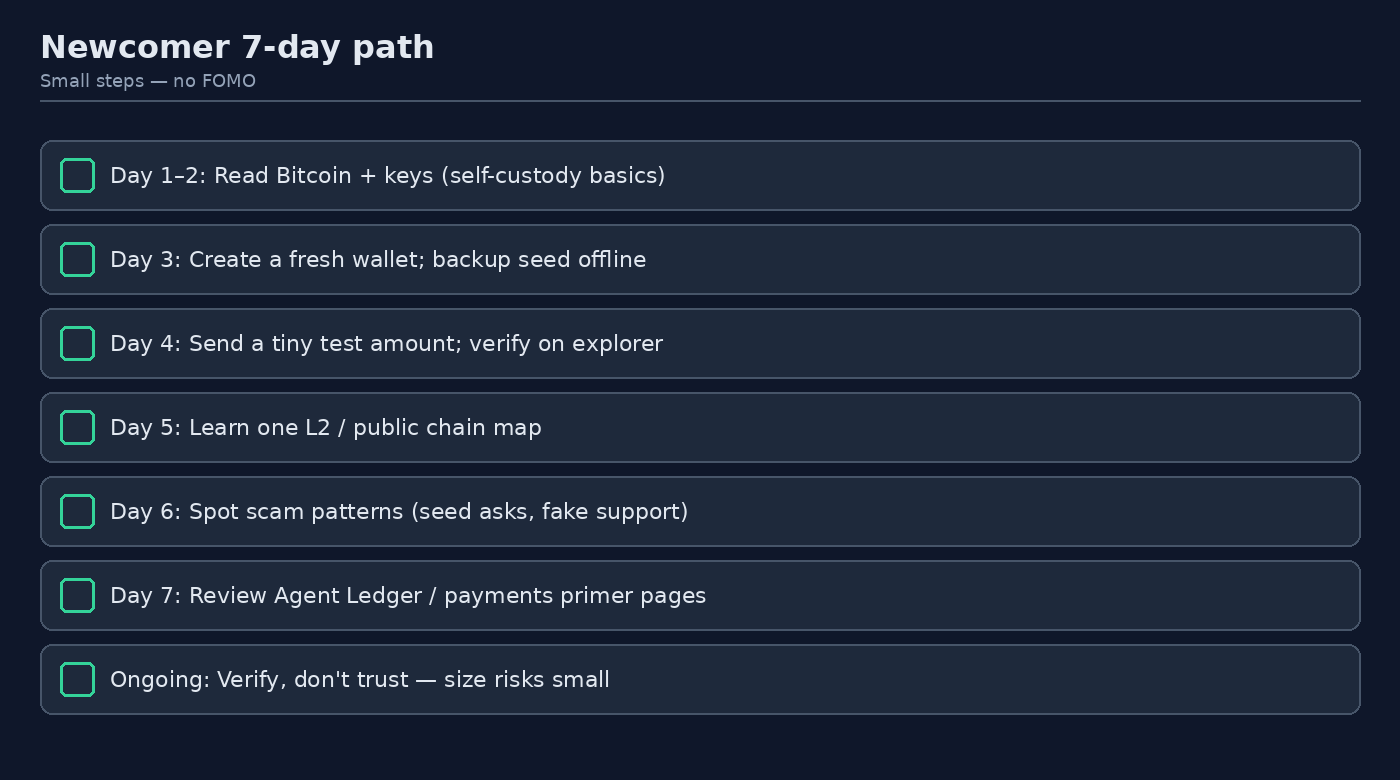
- Separate self-custody from exchange custody.
- Install a reputable wallet; try a tiny amount you can lose (or an official testnet).
- Learn to read address, network, and explorer status.
- Read one signature popup:
approvecan be dangerous. - Back up the seed offline; tell no one.
- Treat “guaranteed profit / insider allocation” DMs as high risk by default.
- Pick one track—Bitcoin, Ethereum+L2, or security habits—beat chasing twenty airdrops.
Laws differ by jurisdiction. Follow yours. This book offers no evasion tips.
Web3 glossary (compact)
The old manuscript had a hundred overlapping entries. Keep a post-chapter survival set; details unfold later.
Infrastructure
- Blockchain / public chain: open ledger and execution environment (Ch. 3).
- Node: machine that runs software to store or verify the ledger.
- Consensus: who proposes blocks and how cheaters are punished (PoW/PoS; Ch. 1).
- Layer 2 (L2): scaling under an L1 security umbrella (Ch. 4).
- Smart contract: on-chain program that runs when conditions are met (Ch. 3).
- Oracle: feeds off-chain data into contracts—often a trust point.
- Bridge: moves assets/messages across chains—historically accident-prone.
Accounts & assets
- Wallet: tool that holds keys and creates signatures.
- Private key / seed phrase: control itself.
- Address: public receive/identity label (pseudonymous).
- Token: transferable on-chain unit; fungible (e.g. ERC-20) or NFT (e.g. ERC-721).
- Stablecoin: token aiming to track fiat etc.—check reserves and issuer risk.
- Gas / fees: payment for inclusion/execution.
Apps & orgs
- DApp: frontend + contracts (decentralization varies).
- DeFi: decentralized finance apps (Ch. 5).
- DAO: on-chain coordination experiments; quality varies wildly.
- TVL: value locked—useful, gameable, never enough alone.
- NFT: non-fungible credential ≠ “must be a valuable picture.”
- Account abstraction / smart wallets: login, recovery, sponsored gas (in progress).
- AI agent: program that calls tools/contracts; permissions and audit beat chat skill.
Security mantras
- Allowance: permission for a contract to move your tokens—over-approval is a theft magnet.
- Phishing: fake sites, airdrops, “support” asking you to sign or export seeds.
- Self-custody vs custody: you hold keys vs someone else—convenience ↔ risk.
Figure index
| File | Role |
|---|---|
assets/ch02/fig01-web1-web2-web3.png |
Web1→2→3 roles |
assets/ch02/fig01-web1-web2-web3-zh.png |
Chinese caption strip |
assets/ch02/fig02-trust-vs-verify.png |
Blind trust vs verify |
assets/ch02/fig02-trust-vs-verify-zh.png |
Chinese caption strip |
assets/ch02/fig03-decentralization-spectrum.png |
Decentralization spectrum |
assets/ch02/fig04-web3-2026-ships.png |
2026 shipped vs still hard |
assets/ch02/fig05-newcomer-path.png |
Newcomer 7-day path |
Original SCDO Lab diagrams; no third-party brand marks.
Chapter wrap
Five takeaways:
- Web3’s core promise is verifiability and self-custody, not guaranteed riches.
- Web1 read, Web2 platform read/write, Web3 tries read/write + ownership—reality is hybrid.
- For decentralization, ask where the single point is.
- 2026 has real pieces (assets, DeFi, L2s, credentials) and loud unfinished stories.
- Newcomer skill #1 is keys and signatures; projects come second.
Next: public chains—what they are, why Ethereum matters, smart contracts and token standards, and a 2026 map without a hype mega-list.
(End of Chapter 2 · v2 English illustrated edition · SCDO Lab)