SCDO Laboratory · TECH PR
UNIT 04
Series · Automated Contract Ledgers for AI Agents · Next-Gen Smart Payments
Scaling & Shards: The Ledger Expressway
L2, shards, and throughput intuition · Author Ying Willam Zhang
4. Layer2
SCDO Lab · Web3 Primer for Newcomers v2 · English edition
Public chains (especially Ethereum) that stay secure and open get crowded—and Gas gets expensive. Layer2 moves most execution to a “second layer” and anchors results back to L1.
The old manuscript had nearly a hundred pages of scaling encyclopedia—v2 compresses to concepts + short cards. Old names like “zkSync2.0 / zkSnyc” are corrected. Not investment advice.
Why scale?
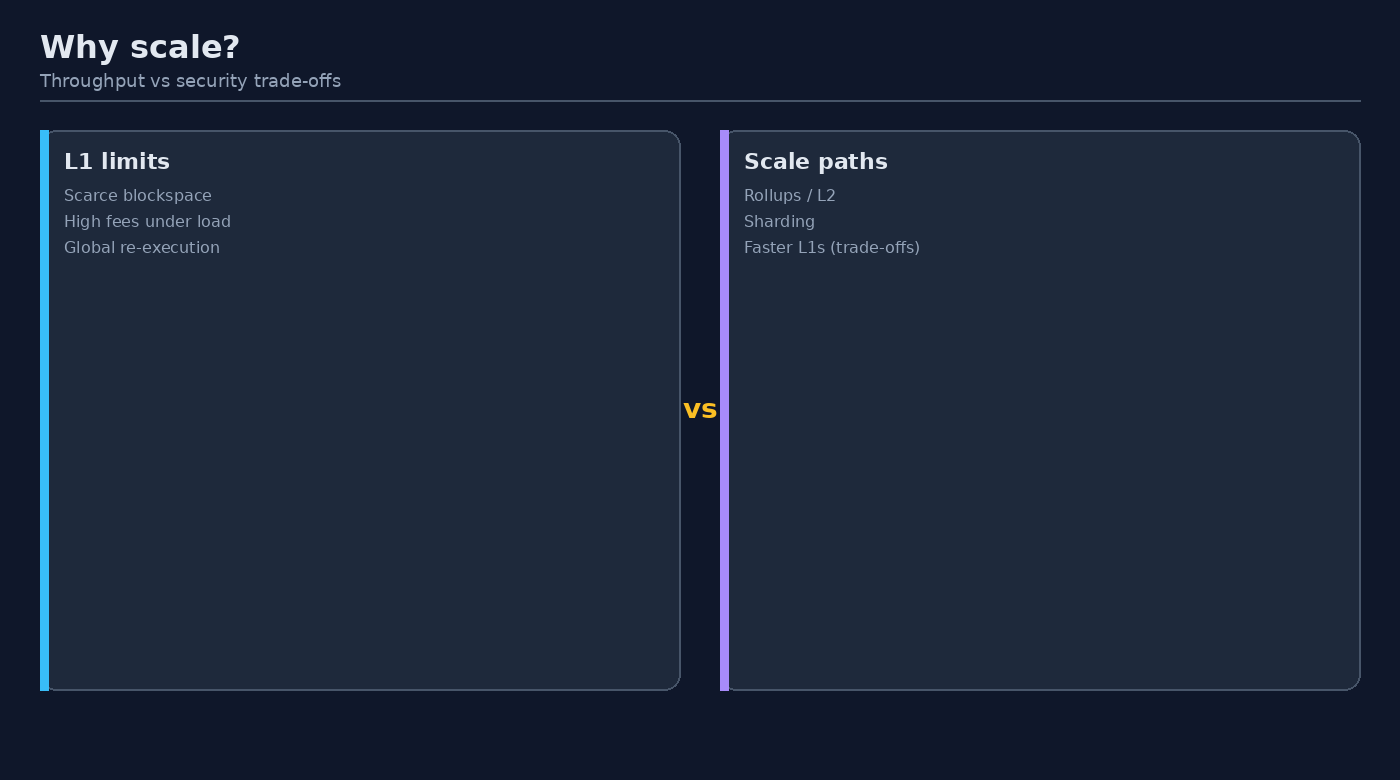
A chain chasing three goals at once fights itself (simplified “impossible triangle”):
- Security (attacks are expensive)
- Decentralization (many can verify)
- High throughput, low fees (many cheap txs per second)
When Bitcoin and Ethereum mainnet prioritize the first two, frequent L1 use hurts: queues, cost, poor UX.
Scaling = let more people afford use while sacrificing as little security and verifiability as possible.
Two broad directions:
| Direction | Approach | Examples |
|---|---|---|
| On-chain scaling | Change L1 itself (bigger blocks, sharding, etc.) | Historic block-size fights; parts of Ethereum’s roadmap |
| Off-chain / Layer2 | Most execution on L2; periodically settle to L1 | Rollups, some channel designs |
In 2026 the common Ethereum-user path is: trust L1 for assets and settlement; do daily ops on L2.
Layer2, sidechains, Rollups: family relations
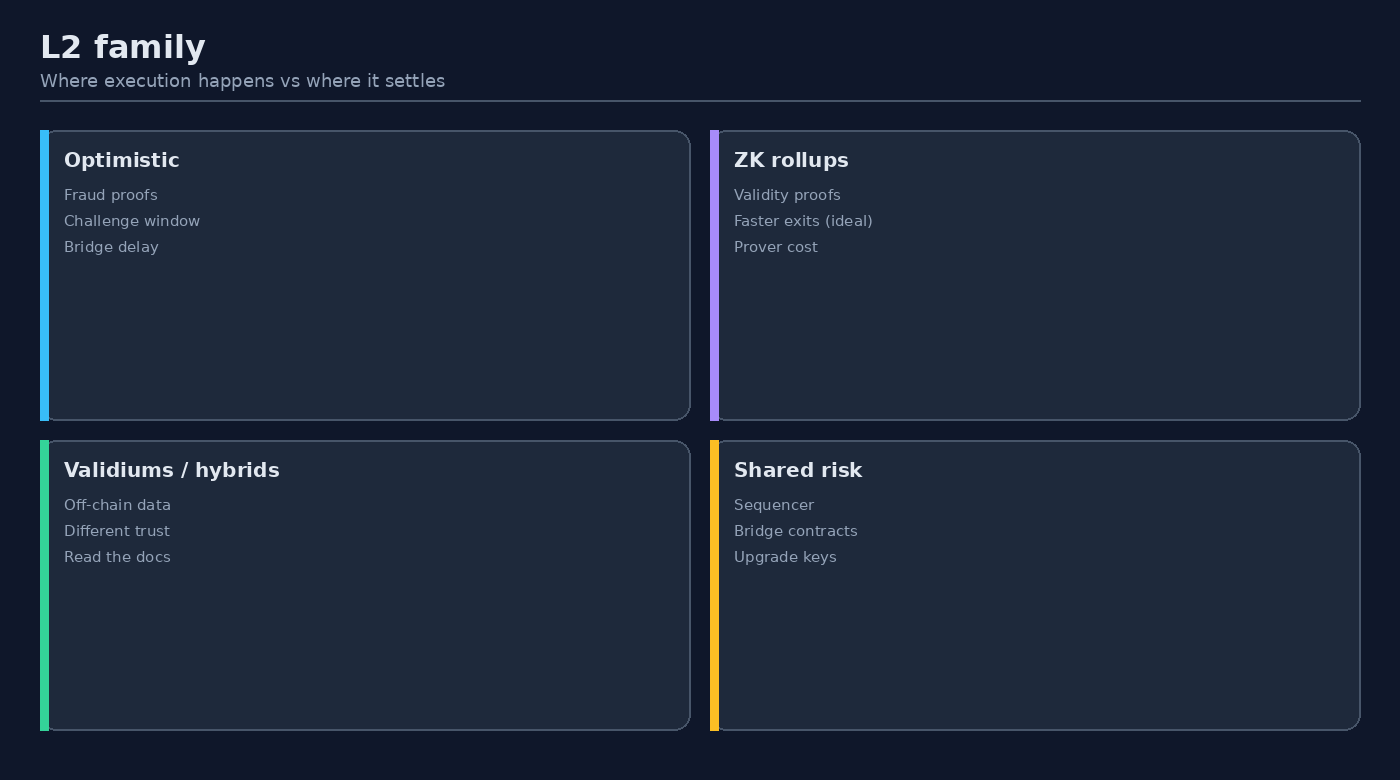
Layer2 (L2) in plain words
An execution layer hanging under some L1’s (often Ethereum’s) security assumptions: txs are processed on L2; critical data or proofs go to L1 so users can (in ideal designs) still rely on mainnet rules to constrain L2.
Not every self-labeled “L2” has the same safety grade—ask: if things break, can L1 data/proofs recover funds?
Sidechains
An independent chain with its own consensus and validators; bridges move assets to/from a parent chain.
Security mainly rests on the sidechain, not automatic Ethereum-grade inheritance. Historical game-sidechain hacks remind newcomers: cheap ≠ equally safe.
Ecosystems like Polygon include sidechain-leaning designs and lines evolving toward Rollups / stronger security inheritance—judge the product, not only the brand.
Rollups
Mainstream Ethereum scaling narrative:
- Execute many txs on L2;
- Post compressed data (or commitments) to L1;
- Use a mechanism so L2 cannot cook the books—fraud proofs or validity proofs.
Two schools:
| Type | How correctness is enforced | Newcomer intuition |
|---|---|---|
| Optimistic Rollup | Assume honesty; challengers can dispute in a window (fraud proofs) | Withdrawals to L1 often wait a challenge period |
| ZK Rollup | Each batch comes with a zero-knowledge validity proof | Proof generation is complex; withdrawal logic differs from OP |
State/payment channels (e.g. Bitcoin Lightning-style ideas) are “off-chain scaling cousins”: high-frequency small payments among relatively fixed parties—not the same product shape as general smart-contract Rollups. We skip the old chronological long-form.
Choosing a path: a sketch
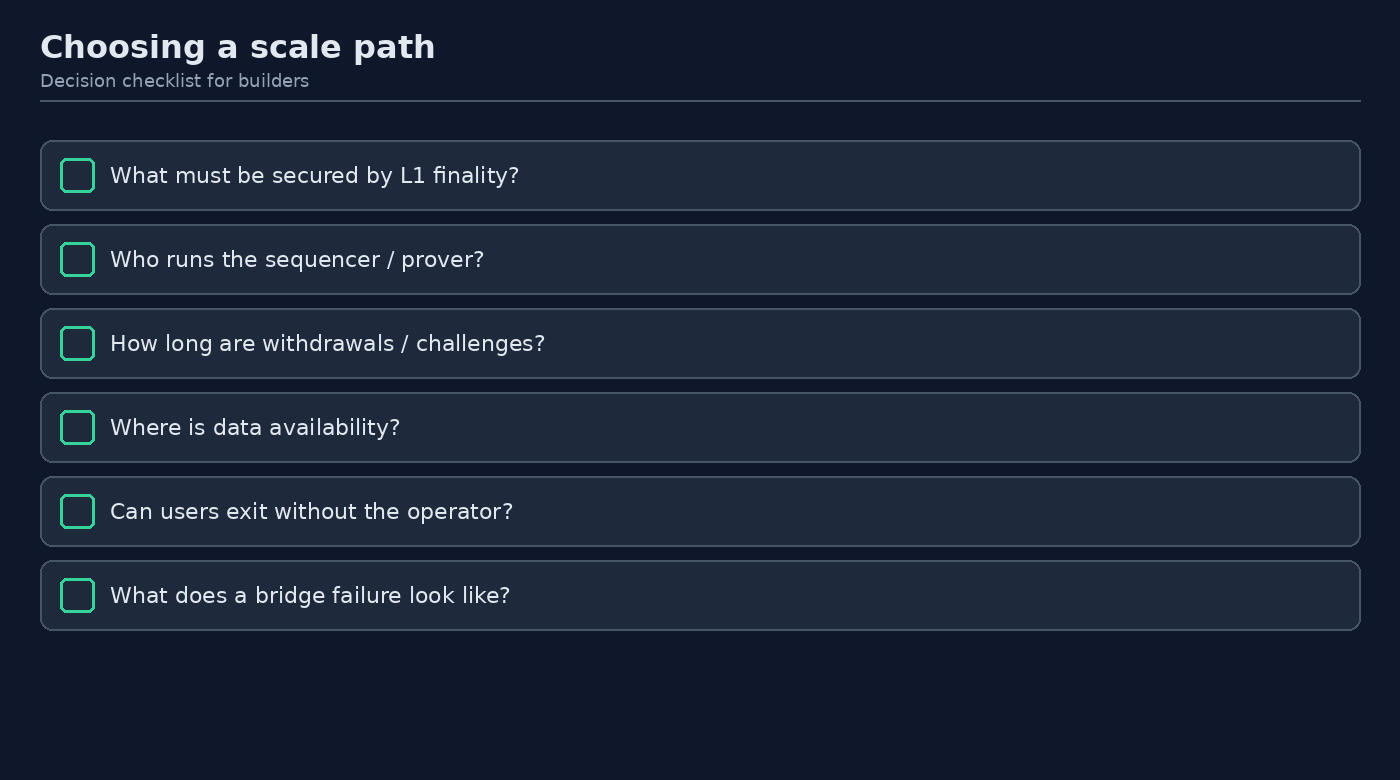
Ask four questions:
- Do I need cheap interaction, or maximum Ethereum security inheritance?
- Can I accept withdrawal delay (common on some Optimistic paths)?
- Are the bridge and official entry the domains I verified? (phishing hotspot)
- Is the app actually deployed on that L2, or only “claimed support”?
Cross-L2 / cross-chain bridges are high risk by default: locked assets, minted wrappers, multisigs or validator sets—large hacks are historical fact. Bridge less; for large amounts, batch and test small first.
Representative short cards (2026, not a ranked buy list)
Map only—not recommendations. Names and product lines change; trust official docs.
Arbitrum (Optimistic family)
- What: a mature Optimistic Rollup ecosystem on Ethereum with strong EVM compatibility.
- You will meet: many DeFi/apps also deployed; Gas cheaper than mainnet.
- Watch: mainnet vs Arbitrum networks; official vs fake bridges; challenge-period withdrawal expectations.
Optimism (Optimistic family) and Superchain narratives
- What: another major Optimistic camp; emphasizes open stacks and many OP-stack chains.
- You will meet: apps, governance, and bridging UX similar-but-not-identical to Arb.
- Watch: “same tech stack” ≠ “same chain, same bridge, same risk.”
Starknet (ZK / STARK family)
- What: ZK path using STARK proofs; language/tooling historically differed from pure Solidity worlds (EVM/DX keep improving).
- You will meet: learning curve; wallets/tools may differ from Arb/OP.
- Watch: account model and official entries before large deposits.
zkSync (ZK family; names corrected)
- Naming: manuscript forms like “zkSync2.0” / “zkSnyc” are outdated or typos. Use the project’s current official product names (and network names in docs), verified against explorers and wallet network lists.
- What: a ZK scaling path toward Ethereum aiming at validity proofs and better fee UX.
- Watch: do not mix mainnet / testnet / product lines; airdrop rumor zones are phishing-dense.
Other words you will see
- Base and other app / OP-stack chains: often tied to an ecosystem or distribution channel—still check what security they inherit.
- Validium / DA trade-offs: cheaper by putting data off-chain; security assumptions change—advanced topic; beginners learn “cheaper often swaps assumptions.”
- Shared / decentralized sequencers: censorship resistance and single points; still evolving in 2026.
Daily L2 habits (more useful than chasing narratives)
- Correct network in the wallet: “missing” funds are often wrong network.
- Bridges and DApps only from official/verified entries; search ads may be fakes.
- Test tiny before scaling; note your address and tx hashes.
- Manage allowances: malicious
approveworks on L2 too. - Read withdrawal rules before exiting to L1: time, fees, official bridge path.
- Do not conflate sidechains, Rollups, and custodial “one-click cross-chain”—underlying trust parties differ.
One SCDO Lab link
Scaling makes automated agents (AI agents) able to afford on-chain actions—and makes mistakes and drains happen faster. Even cheap L2s need: spend limits, auditable logs, revocable permissions—why Agent Ledger talk stresses: speed serves business; traces serve accountability.
Deeper: where data lives, who sequences, how funds return to L1
Data availability (DA)
For others to check L2 honesty, enough data must be obtainable. Data on Ethereum inherits more security and costs more; elsewhere is cheaper with different assumptions. Beginners need not memorize every acronym—remember the trade-off: cheaper often means more extra honesty assumptions.
Sequencers
Most L2s today still have a centralized or semi-centralized sequencer ordering txs and giving fast confirmation. Smooth UX comes with:
- Downtime → temporarily painful;
- Censorship → some txs delayed;
- MEV → ordering itself has value.
Long-term roadmaps discuss decentralized and shared sequencing; 2026 is still “product UX first, decentralization catching up.” Treat the sequencer as a visible single point, not pretend it is absent.
Exits and bridges
- Official bridges: clearer rules; Optimistic withdrawals may wait challenges.
- Third-party / liquidity bridges: faster, extra trust and contract risk.
- CEX deposit/withdraw: convenient; essentially custodial accounting.
Choice depends on size, urgency, and whom you trust. There is no free lunch of “fast + zero trust + zero learning.”
Bitcoin side paths and “other L2s”
Ethereum L2s are loudest, but scaling ideas are not exclusive. Bitcoin has Lightning-style channels; other L1s have their own L2s or app chains. Cross-ecosystem naming is messy—some call every sidechain an L2. Judge by security inheritance, not marketing labels.
How to read L2 news (don’t be a fan)
Force five questions:
- Evidence system: Optimistic, ZK, or none?
- Where is transaction data published?
- Who holds upgrade keys; is there a timelock?
- If assets stick, what social/technical exit exists?
- Are fake official sites phishing lately?
Muscle memory beats memorizing TVL ranks.
Fee intuition
L2s cut execution and congestion cost, not magic free rides. Congestion, complex contracts, allowances, and bridges can still spike. Habit: check estimates before send; split large moves.
One line for builders (not a tutorial)
If you ship apps: document which L2 users enter from, how the official bridge is described, and how wrong-network mistakes are blocked. Many “lost coins” are UX failures. Teaching users to pick the network is part of product duty.
A newcomer’s day (story)
Suppose you hold a little ETH on mainnet, want a DeFi app, and Gas scares you off. You add an L2 network (or your wallet already has it), copy the bridge address from official docs—checking every letter of the domain. You bridge ~$5 equivalent first: minutes later (or longer), the explorer shows L2 arrival. You do a small swap; Gas is clearly cheaper. You note: mainnet and L2 addresses often match, but balances are per network; wrong network feels like “coins vanished.” After playing, you decide whether to bridge back and budget wait time and fees. The day did not make you rich; it built muscle memory better than ten AMAs.
Unknown signature? Refuse. DM “your bridge failed, fix here”? Treat as scam. Official bridge congested? Wait rather than jump to a strange fast bridge on day one. Keep that paranoia—L2s cheapen txs and also cheapen fraud’s marginal cost.
Advanced: one ecosystem may have many chains and similar testnet/mainnet names. Habit: check chainId / explorer URL before signing.
FAQ (L2)
Q: Are L2 coins the same as mainnet?
A: Balances are per network; addresses often match, but different networks are different ledger views.
Q: Why do withdrawals sometimes take long?
A: Some Optimistic paths have challenge windows; third-party bridges trade time for different trust.
Q: Is a sidechain an L2?
A: Not necessarily. Judge whether security depends on the parent’s data/proofs—not ads.
Q: Which L2 should I pick?
A: Where your app lives, whether the bridge is official, client/community maturity—not a single TVL screenshot.
Q: Are “zero Gas” campaigns safe?
A: Sponsored Gas can be account abstraction—or phishing wrapping; still read signatures.
Values inside scaling debates
Surface fights are about throughput; deeper fights are values: who may sequence? who may upgrade contracts? can users force-exit via L1 if the sequencer misbehaves? Different answers yield different products. Some accept a bit of centralization for silky payments; others prefer costlier maximal independence from one company. No unique right answer—but marketing slogans as security proofs are wrong answers.
Ethereum scaling history rotated state channels, Plasma, sidechains, Optimistic Rollups, ZK Rollups through the spotlight. Losers were not always “scam tech”—often engineering/UX lagged, or security models failed mainstream acceptance. Today’s winning narrative may rewrite in three years. This book uses cards, not a final ranking. You will change phones and default L2s; migration cost is assets and habits, not loyalty.
For institutions, custodians may bundle account abstraction + sponsored Gas + allowlisted contracts—another trust model: convenient, partially Web2 again. Education’s goal is not forbidding convenience; it is making you name whom you trust. If you cannot name them, do not deposit more than insomnia money.
Builders/ops: screenshots that say “pick the right network,” disable dangerous buttons on wrong networks—beats ten threads. L2s cut on-chain fees, not communication fees—and communication fees are the real Gas of most user asset accidents.
Shards: another relative of scaling
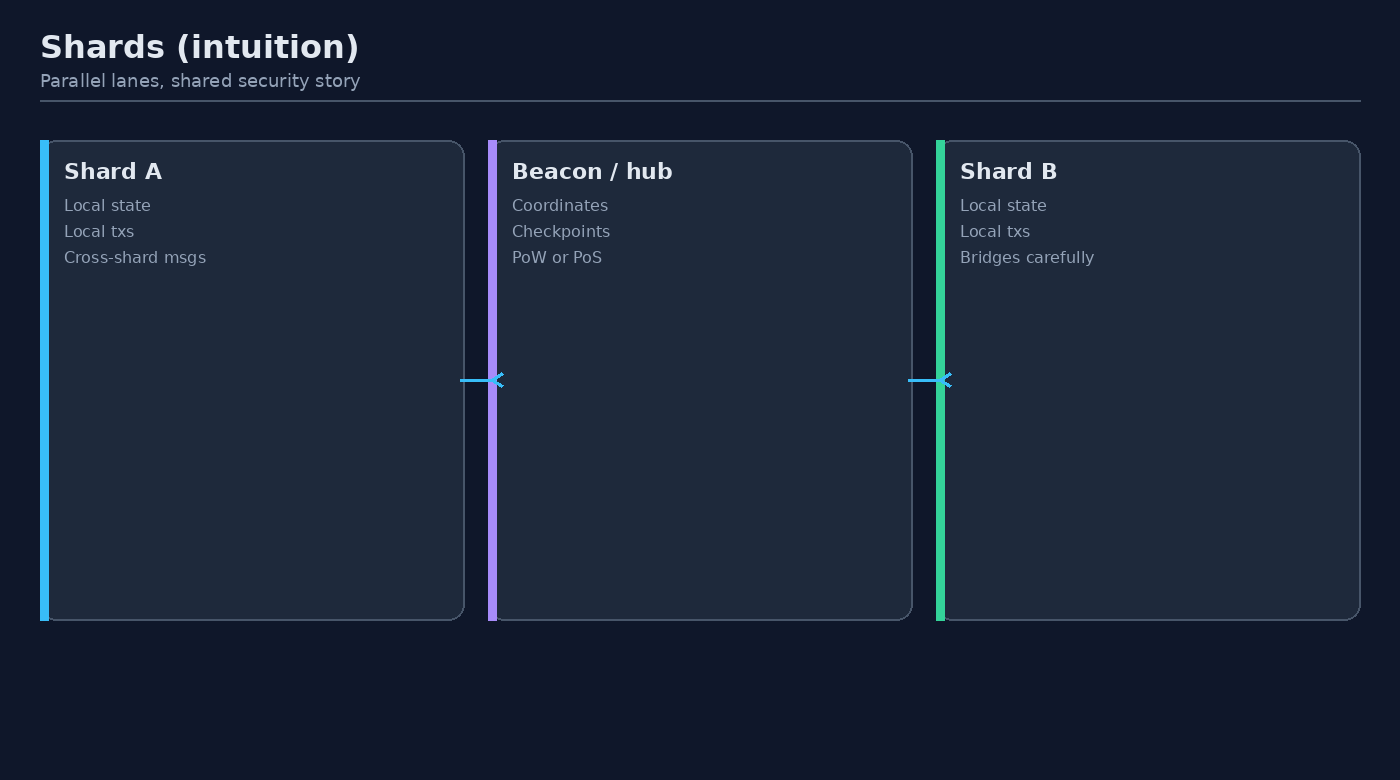
Layer2 is “another floor on top.” Sharding splits one large chain into parallel lanes: accounts and transactions are partitioned; cross-shard moves use dedicated bookkeeping (e.g. Classic Debt).
| Idea | One line |
|---|---|
| Local blocks | Produced and confirmed inside a shard |
| Cross-shard | Sender shard records first; recipient shard credits after checks (details vary) |
| vs Rollups | Shards are often peer chains in one family; Rollups usually settle back to one L1 |
SCDO layout (2026, educational): Classic Shards 1–4 use ZPoW; a peer Shard0 EVM (Ethash, chainId 5680) hosts contracts and Agent Ledger. Details: Chapter 10 (SCDO) and Chapter 11 (Mining). Here you only need the map: shard ≠ sidechain ≠ Rollup.
Chapter wrap
- Crowded L1s need L2s; in 2026 much Ethereum activity is on L2.
- Sidechain ≠ Rollup; whether security inherits L1 is the soul question.
- Optimistic uses challenges; ZK uses validity proofs—UX and withdrawals differ.
- Memorize cards, not encyclopedias; bridges and fake sites kill faster than “wrong narrative.”
- Next: DeFi—how swaps, lending, and market-making work on these L1/L2s, and where risk lives.
(End of Chapter 4 · v2 English edition · SCDO Lab)