SCDO Laboratory · TECH PR
UNIT 06
Series · Automated Contract Ledgers for AI Agents · Next-Gen Smart Payments
On-Chain Ownership: NFT & Metaverse
Digital asset provenance and scene limits · Author Ying Willam Zhang
6. NFT and the metaverse
SCDO Lab · Web3 Primer for Newcomers v2 · English edition
NFTs are on-chain non-fungible credentials; the metaverse is a larger, fuzzier narrative basket.
Turn down 2021–22 hype; Sandbox / Decentraland are cases, not “must-buy leaders.” Not investment advice.
What is an NFT?
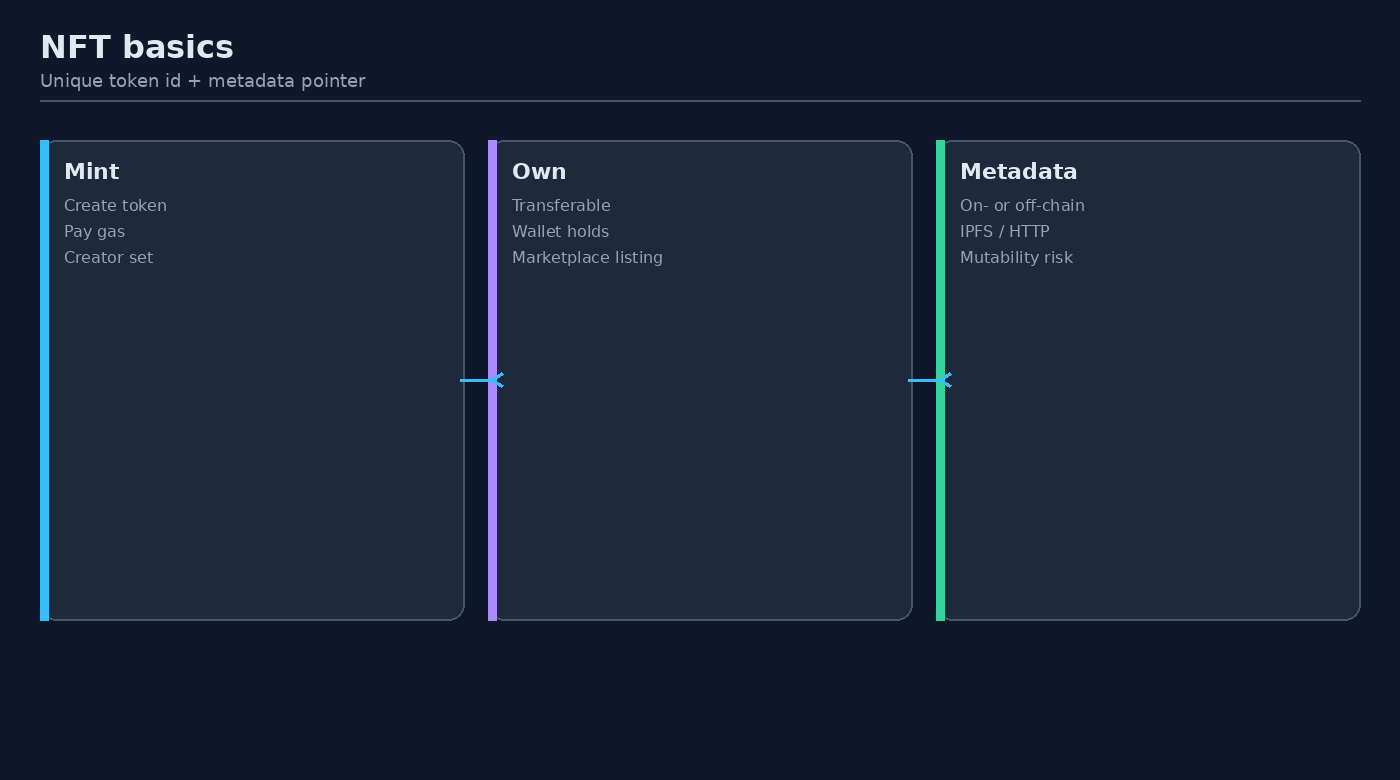
NFT (Non-Fungible Token): each token has a unique ID and cannot be swapped 1:1 indistinguishably like ERC-20. Common Ethereum standards: ERC-721, also ERC-1155, etc.
Plain: an NFT is more like an on-chain title/badge number proving “this contract’s this ID currently belongs to this address.” It does not automatically mean:
- You own copyright in the image file (often separate);
- The project will operate forever;
- Floor price only goes up.
Infrastructure you will actually meet
- Issuance contracts: mint rules, royalty interfaces, upgradeability.
- Metadata: name, image links—on-chain, IPFS, or a central server (server dies → image breaks).
- Marketplaces: display and trade frontends—also fake sites.
- Wallets: show NFTs, sign listings and approvals.
Uses that actually make sense (rough reliability order)
- Tickets and access: on-chain tickets reduce fakes; still watch scalpers and fake mints.
- Membership and permissions: hold NFT X to enter a community / unlock features.
- Game items and cosmetics: tradable and portable in the ideal case; bad economies still collapse.
- Certificates and achievements: courses, contributions, attendance—issuer reputation matters.
- Collectibles / art: culture and speculation coexist; most go to zero—normal market distribution.
Bitcoin-ecosystem inscriptions and peers also “carve / attach unique data to chain assets”—standards and risk models differ from Ethereum NFTs; point only here.
What the bubble taught
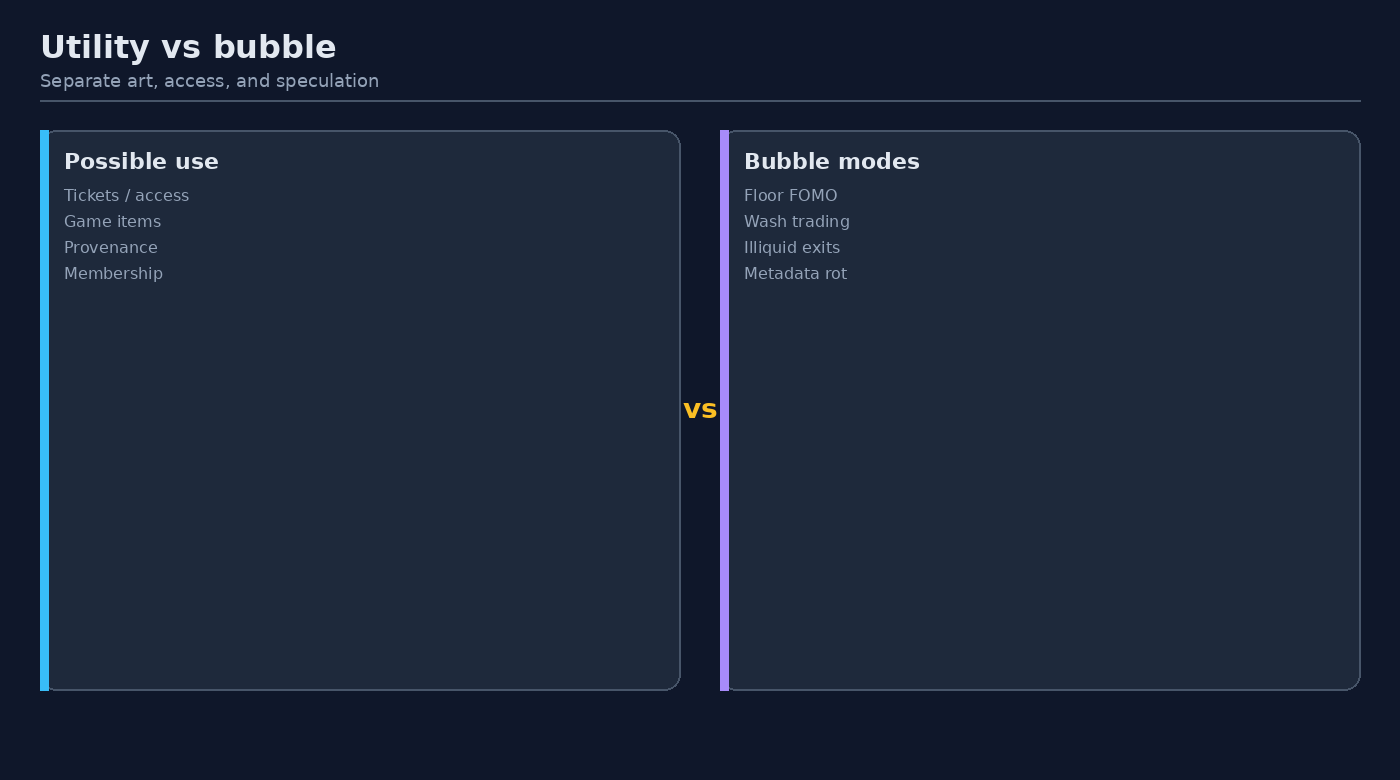
Around 2021: avatar JPEGs, sky-high floors, celebrity shills, everyone minting. After the drawdown:
- One-way liquidity: easy to sell in bulls; no bids in bears.
- Royalties and marketplace rules change: creator cuts are not physics.
- Wash trading can fake floors and volume.
- Phishing mints, fake support, stolen approvals zero you faster than “wrong fundamentals.”
- IP chaos: people sell rights they never had.
In 2026, healthier questions: whose problem does this credential solve? If speculation stops, does it still exist?
Metaverse: concept, volume down
Concept
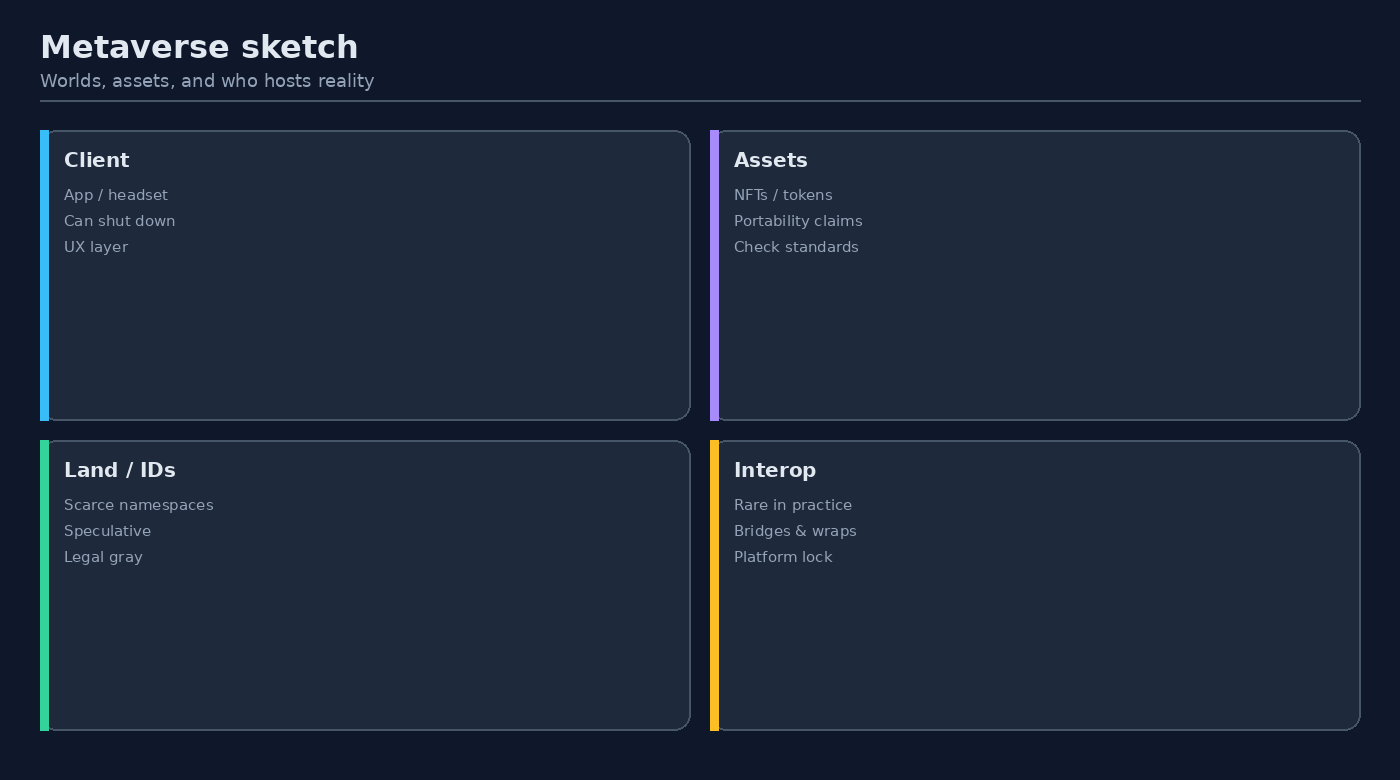
No single definition. Marketing often means: persistent shared virtual spaces + identity + economy + interactive content. Tech may include game engines, social, creator tools, payments, sometimes blockchain items and land.
Commonly listed traits (not promises)
- Persistent “world” feel;
- Editable / creatable;
- Digital identity and social;
- Economic systems (may include on-chain assets);
- Links to real scenes (events, brands, remote work).
Blockchain is not a sufficient condition for a metaverse: many virtual worlds run fully centralized. On-chain parts mainly offer verifiable digital ownership and possible interoperability—“possible” matters; cross-world portability remains hard.
Relation to NFTs
NFTs often play land deeds, outfits, tickets. Without a living world and players, deeds are quiet JSON. Conversely, good games need not be on-chain first; ask whether anti-fraud, markets, and open economies truly require a chain.
More realistic directions
Brand virtual launches, remote concerts, training sims, industrial digital twins—often do not require buying “on-chain land” first. Equating the metaverse with “buy land, get rich” is the most misleading newcomer simplification.
Cases: The Sandbox and Decentraland (not leader shills)
Both early combined tradable virtual land/experiences with crypto wallets and were once called “metaverse representatives” in media.
How to read cases:
| Dimension | What to observe |
|---|---|
| Product | Are people still creating and gathering inside? |
| Assets | Are LAND-class NFTs for in-world production or pure speculation? |
| Company / foundation | Who sets rules? Who expands the map? |
| Cycle | Hype rides markets and narratives—drawdowns are normal |
| Lesson | Virtual real-estate valuation is fragile; traffic acquisition is costly |
v2 is explicit: learning samples, not a “2026 must-buy pair.” Many peer worlds exist—some more chain-game, some more UGC platforms. Pick worlds by content and community, not headline count.
Newcomer checklist
- Separate collecting preference vs speculation; treat the latter as able to go to zero.
- Before mint: contracts, supply, free-mint traps (allowance drains).
- Ask hosting: IPFS? centralized URL?
- Ignore “floor-bot guaranteed profits.”
- Metaverse land: ask “will I use it” before “will it pump.”
- AI art + NFT: provenance and originality disputes grow—read licenses.
Metadata and “broken image” problems
Buying an NFT often buys: a tokenId + a metadata pointer. If images live on the project’s server, shutdown breaks images. IPFS / on-chain data resist censorship better but are not infinite free disk. Ask: is metadata frozen? what is the backup plan?
Creator royalties were once treated as default; some markets later made them optional—creator/platform bargaining continues. Do not write “forever royalties” into financial fantasies.
Royalties, licenses, copyright
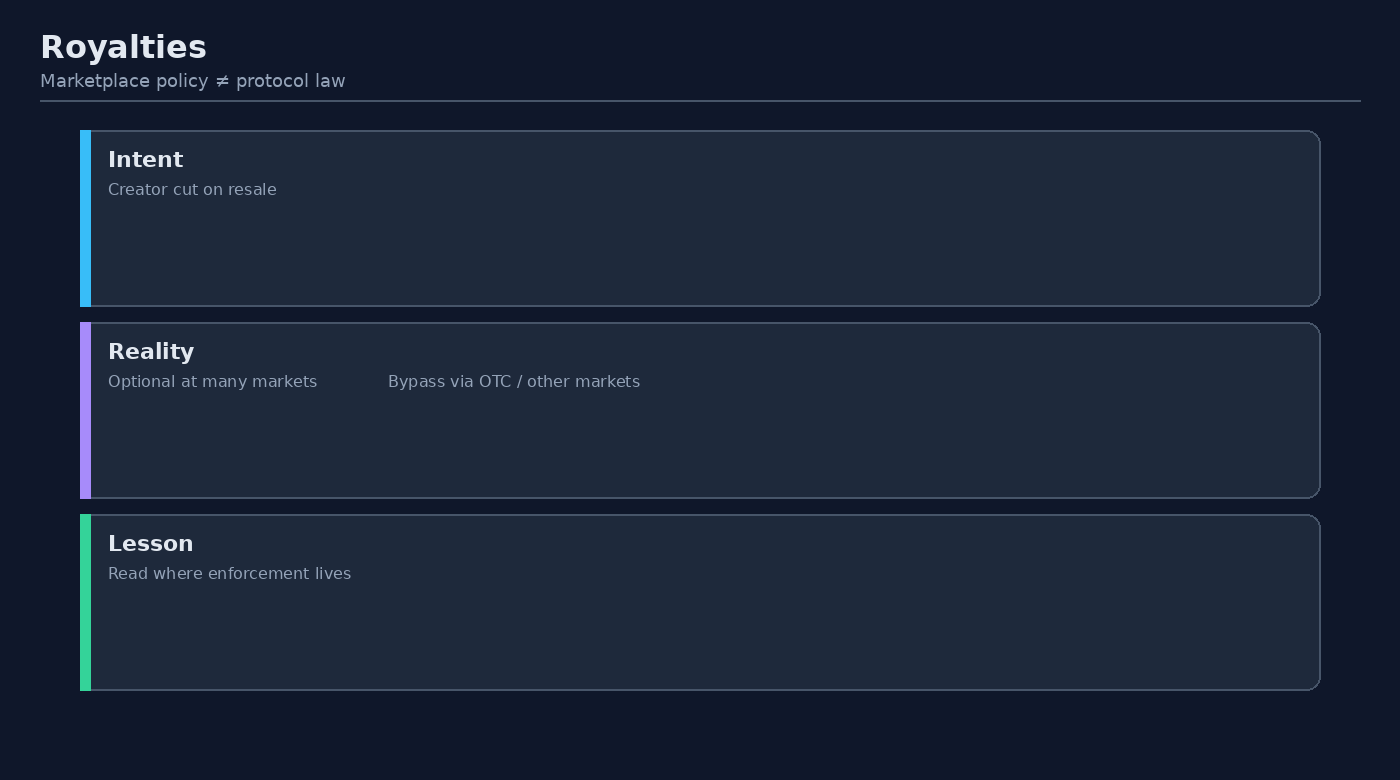
On-chain transfer ≠ automatic commercial copyright. Read the project license (derivatives? commercial use?). AI-generated mints muddy copyright further—litigation and platform policy still evolve. Read terms before collecting or commercial use.
Identity NFTs and “soulbound”
Some credentials are non-transferable (or hard to transfer) for reputation, eligibility, attendance. Upside: less pure speculation. Downside: privacy and discrimination risk (soulbound to an address can be tracked). Good designs consider minimal disclosure, revocation, refresh.
Metaverse landing checklist
If your team builds a “world” rather than a story:
- Frame rate and feel good enough?
- Creator tools usable by ordinary people?
- Economy runs without token subsidies?
- Identity useful across contexts—or only land JPGs?
- Moderation, child safety, harassment handling planned?
If unanswered, it is still marketing metaverse.
Practical brand / ticketing fits
In 2026 success more often looks like: concert anti-counterfeit tickets, membership year cards, digital keepsakes—small clear rights, not “buy land, become a digital landlord.” SCDO view: credentials serve verifiable events, not empty real-estate myths.
After avatar culture
Avatar NFTs were social currency: Discord access, allowlists, recognition. After the wave, the plainer question remains—how to verify digital identity cheaply without KYC every time. Tickets, memberships, event badges, course completion can be NFTs or verifiable credentials. Success becomes: smooth redemption, hard forgery, users completing flows with custody or smart-wallet help while understanding custody costs.
For artists: on-chain auctions lower geography barriers and bring platform cuts and plagiarism. Protect with watermarking, provenance, counsel—not “mint first, think later.” For brands: small credential experiments beat airdropping hundreds of thousands of unused images.
If you still use “metaverse,” prefer “persistent multiplayer online world + optional on-chain assets.” Honest wording filters half the fundraising talk.
FAQ (NFT)
Q: Rising floor = quality?
A: Not necessarily; wash trades or transient liquidity.
Q: Listed on a marketplace = I own copyright?
A: Usually not automatic copyright transfer.
Q: Are free mints always losses?
A: Not always—but often allowance phishing; read wallet prompts.
Q: Can I buy metaverse land?
A: Treat as entertainment/experiment budget—not must-have housing.
Q: How do I send an NFT to a friend?
A: Confirm network and address; test small.
Market structure and creator bargaining power
NFT market competition once centered on fees and royalty toggles. Creators want secondary cuts; traders want low friction; platforms want share. Policy flip-flops followed. For creators, stabler income often comes from primary sales, commissions, brand deals—not assumed perpetual royalties. For collectors, separate: community ticket, art preference, or greater-fool speculation. They can overlap; loss psychology differs—stacking them invites self-deception.
When museums try on-chain collection IDs, the point is often provenance and education—not floors. That use pulls NFTs back toward “credential.” Games and tickets likewise. Off the trading-screen dopamine, long-term value depends on offline/online rights delivering: entry, redeem, upgrade. Read the rights sheet before buying; no sheet → treat as decoration.
On metaverse land: buildability, traffic, and interoperability decide stage vs wasteland. Slicing land into many NFTs helps speculation; it does not auto-produce audiences. Audiences come from content and social; content from tools and incentives; if incentives are only inflationary tokens, audiences leave. Budget levels and live ops usually beat “two more virtual street corners.”
From speculation screens back to usage rights
When volume falls, surviving NFT uses almost all bind usage rights: door scan works, ticket redeems, membership unlocks, in-game gear works. Design to that north star—healthier than rarity tables. Issuers should publish rights duration, whether rights move on transfer, failure/refund rules; collectors should treat those as pre-purchase reading, not post-hoc slogans.
Technically, dynamic NFTs (updatable metadata) fit game state and membership tiers—and introduce central switches: who updates? are updates logged on-chain? Static NFTs are simpler but hard to express growth. Choice is situational.
Cross-chain NFTs and “wrap bridges” add mapping errors and fake-bridge risk. If rights work on one network you understand, do not bridge for multi-chain flex. Teaching users with “which city’s theater holds the ticket” often beats explaining cross-chain messaging.
For teams like SCDO that emphasize verifiable records, NFT/credentials should prioritize proof that events happened (compete, settle, achieve)—not new land illusions. Proofs should be verifiable, expirable, privacy-aware—trade-offs belong in product docs, not slogans.
Compliance display and minors
When NFTs enter schools, museums, or youth events, content ratings, privacy consent, and guardian authorization hit walls before chain tech. Educational credentials should avoid hard-binding public addresses to real identities; selective disclosure is better. Commercial activity must handle invoices, withdrawal rights, and false advertising—“guaranteed forever appreciation” language is a minefield. Bring counsel into design; cheaper than deleting posts later.
Cross-jurisdiction digital loans for exhibitions need clear authorization and minting rights so one tokenId does not carry two rights narratives. Standards are unfinished; until then contracts are the main language, chain the attachment.
Chapter wrap
- NFT = unique on-chain credential; use cases beat avatar speculation.
- Bubbles proved: high valuations without real demand do not last.
- Metaverse is a basket; blockchain is an optional part.
- Sandbox / Decentraland are cases, not must-buy lists.
- Next: decentralized social—when posts and follow graphs want protocols, what federation, Lens, and Nostr each compromise.
(End of Chapter 6 · v2 English edition · SCDO Lab)