SCDO Laboratory · TECH PR
UNIT 08
Series · Automated Contract Ledgers for AI Agents · Next-Gen Smart Payments
GameFi: Play That Proves Itself
On-chain economies and verifiable records · Author Ying Willam Zhang
8. GameFi
SCDO Lab · Web3 Primer for Newcomers v2 · English edition
GameFi ≈ games + financial incentives (token/NFT economies). Fun and “earn” often fight.
No “explosive growth” tone.
Not investment advice.
How GameFi relates to DeFi
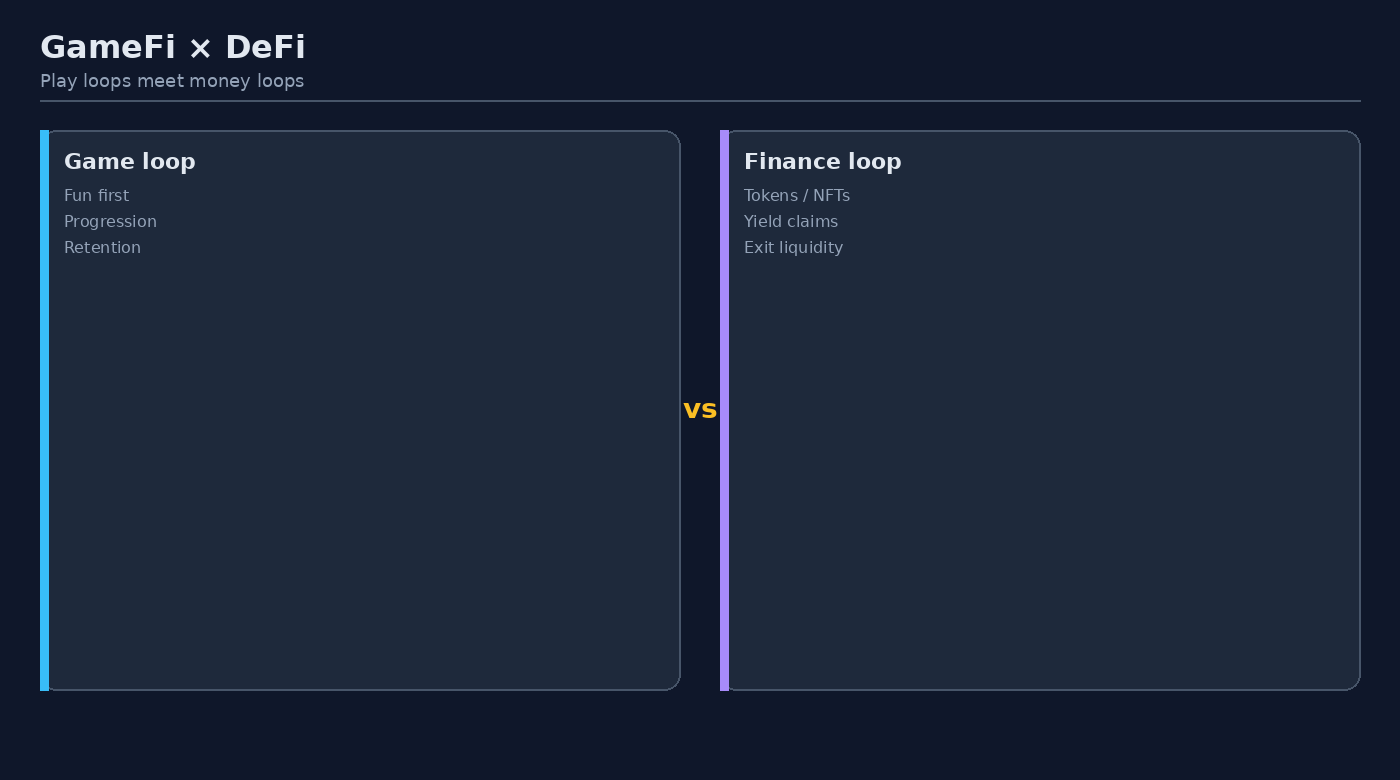
- DeFi: financial Lego itself (swaps, lending, market-making).
- GameFi: game loops (quests, combat, progression, land) drive people to hold, spend, and trade tokens/NFTs; under the hood often reuses DeFi pools, markets, and bridges.
Plain: DeFi is the exchange and pawnshop; GameFi wants “play while participating in an economy.” When it fails, it looks like a game but the core is high-inflation Ponzi—telling them apart matters.
Tiny origin
Early chain games started from collectibles and simple play; a “play-to-earn” phase pulled in labor-style players—and collapses. The industry later talked more about Play-and-earn / Play-to-own, off-chain play + on-chain assets, and “fun first, tokens later.”
Why put games on-chain?
Reasons that can make sense:
- Portable assets: items/characters are not solely one server DB’s truth (ideal case).
- Transparent trading: secondary market rules more public (fakes and phishing remain).
- Open economies: third parties build tools and markets (also bots and extraction).
- Verifiable randomness / settlement: some genres need publicly checkable outcomes.
Reasons that do not:
- “On-chain automatically more fun”;
- “Issuing a token cold-starts eternal inflation prosperity”;
- “Metaverse land must appreciate.”
Common types
| Type | Trait | Risk sketch |
|---|---|---|
| Labor / P2E | Time → tokens | Token dump; not enough newcomers → collapse |
| Collectible competitive | NFT characters/skins + matches | Floor bubbles, match quality |
| UGC sandbox | User content / land | Traffic and tooling barriers |
| Off-chain play + on-chain settlement | Feel in traditional clients | Bridge and custody complexity |
| Casino skins | High-odds “games” | Regulation and fairness questions |
Sustainability: watch death spirals first
Healthy games: fun → voluntary spend/trade → economic balance.
Fragile GameFi: reward tokens → sell pressure → prices crash → players leave → only charts remain.
Design questions:
- Without token rewards, would anyone still play?
- Do sinks keep up with sources?
- Do guilds/studios monopolize production?
- Are assets utility or pure speculation tickets?
2026 industry map (schematic, no name-dropping shills)
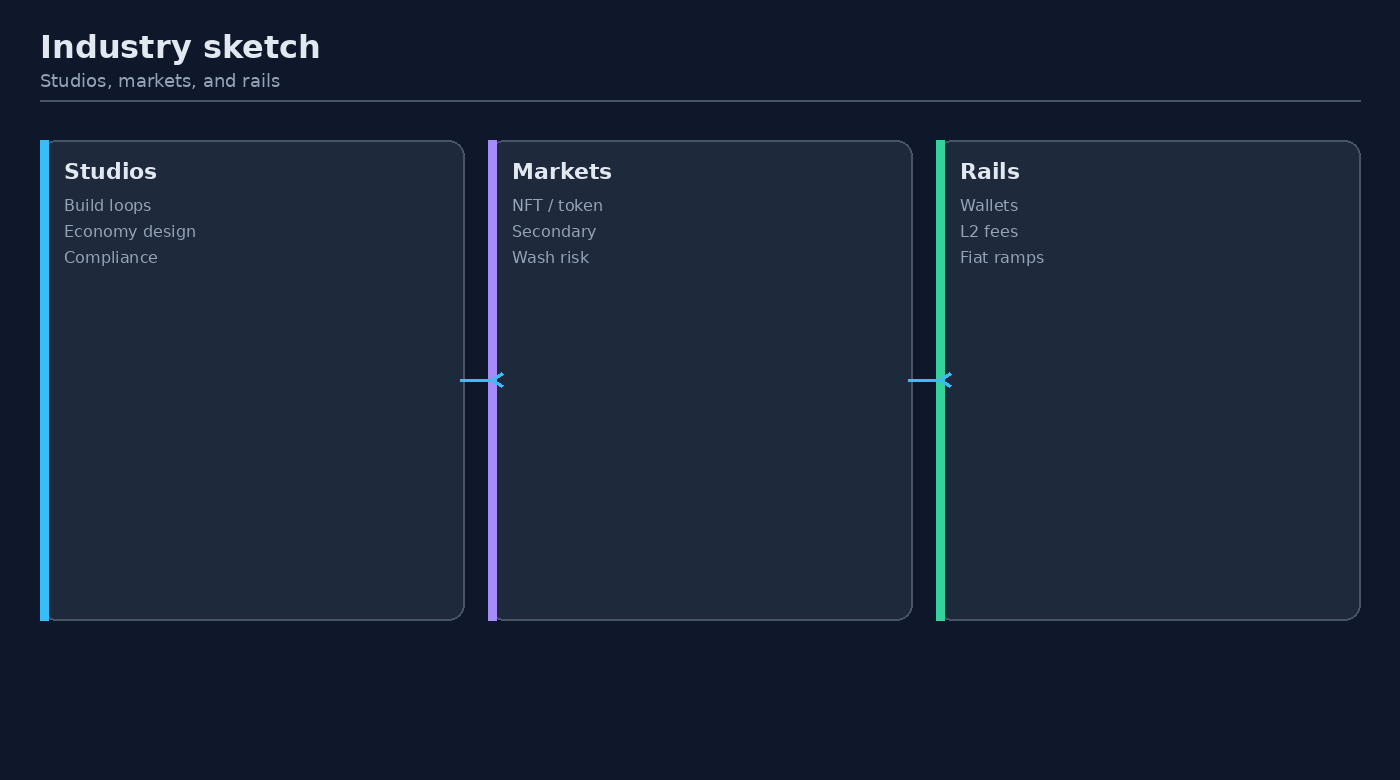
Players / guilds
    ↓
Game clients & engines ← publishers / studios
    ↓
On-chain assets (NFTs/tokens) ← markets, bridges, wallets
    ↓
Public chains / L2s / app chains
    ↓
Liquidity & financial services (swaps, lending—be careful leveraging “earn”)
Periphery: analytics, anti-cheat, security audits, compliance, creator tools.
Name lists go stale; learn roles, not last year’s “must-play” charts.
Newcomer rules
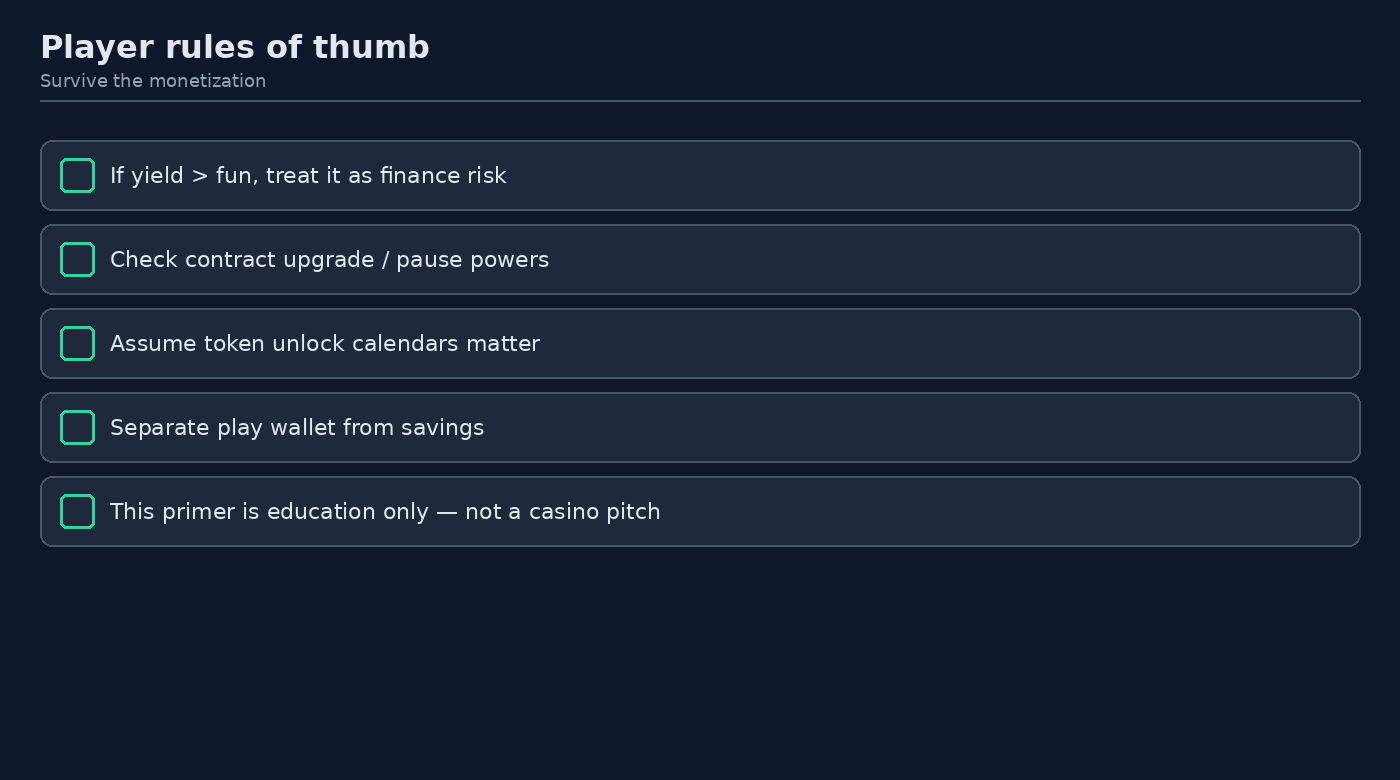
- Try play before talking earn.
- Stress-test P2E income as able to go to zero.
- Approve game contracts sparingly; dedicated burner wallets.
- Watch “guaranteed daily yield” and “insider blind boxes.”
- Mind local gambling and token-game regulation.
Economy design vocabulary
- Source: quest rewards, drops, mining.
- Sink: repair, crafting, tickets, burns.
- Soft/hard caps: is inflation bounded?
- Seasons: periodic resets ease permanent inflation.
- Dual/multi-token: separate governance and game currencies—complex, can confuse players more.
Good design is city traffic: inflows and outflows; bad design is flyer-style money printing.
Guilds, studios, and labor
In P2E eras guilds organized labor, split devices and accounts. Efficient—and turns individuals into pyramid bottoms. Before any “team coaching,” clarify contracts: who holds keys, how revenue splits, who owns security on exit.
Common technical architectures
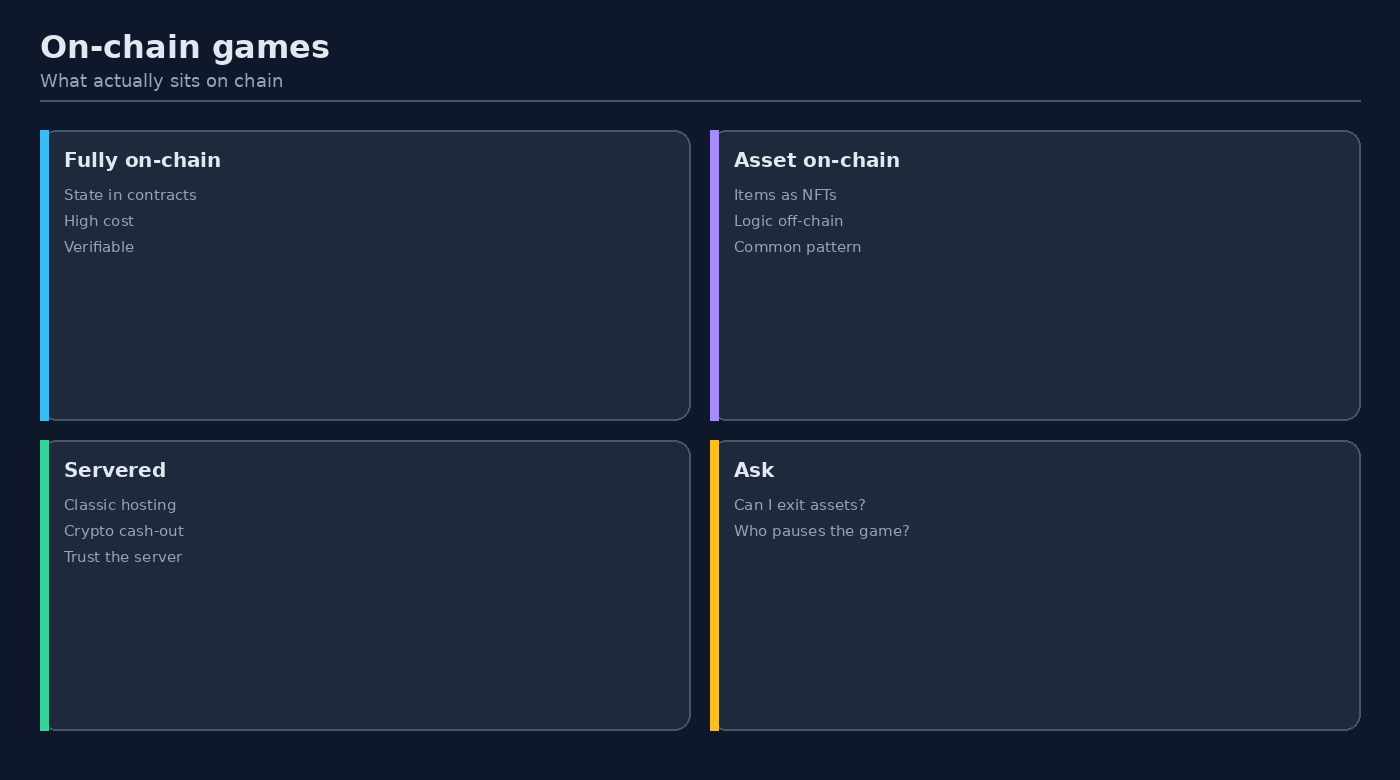
- Fully on-chain: transparent but costly/slow—strong settlement, weak twitch feel.
- Big off-chain world + on-chain assets: better feel; trust servers + bridges.
- App chains: custom performance; build your own security and liquidity.
No silver bullet. Ask what claim path exists if theft or shutdown happens.
Regulatory radar
Some designs approach gambling or securities issuance. Definitions differ by country. Before launch or mass acquisition, get legal advice—this book only educates; it does not provide evasion structures.
Healthy participation checklist
- Budget: entertainment money, not rent.
- Wallet: dedicated.
- Time: anti-addiction; P2E easily becomes another job.
- Info: official channels; Discord account theft is common.
- Exit: predefine “stop after X% drawdown.”
From player to builder boundaries
Studios: ship a fun 30-minute vertical slice before token design. Economy advisors and gameplay designers at the same table—not tokens first, gameplay later. Guilds: bake security training into policy; never require members to hand over seeds. Investors (high risk): treat GameFi tokens like high-volatility early-venture substitutes—not wages.
Content pipelines (art, levels, live ops) do not vanish because of chains. Blockchains replace some asset/settlement assumptions. Ignore content cost and you are left with price charts in a browser.
If SCDO-related experiments exist, sell fair competition, verifiable scores, and entertainment itself—not “guaranteed earn.” Business-development pitches stay out of this book.
FAQ (GameFi)
Q: Can P2E still work?
A: Treat as high-risk short labor; default the yield curve sloping down.
Q: Game NFT floor crashed?
A: First ask if anyone still plays; prices without gameplay rarely recover.
Q: Guild wants my seed phrase?
A: Refuse—hard red line.
Q: Must chain games have tokens?
A: No; Web2 accounts + optional on-chain assets first is fine.
Q: How to tell if a studio is serious?
A: Update cadence, playable builds, economic transparency—not roadmap adjectives.
Content pipelines, anti-cheat, and the livestream era
If chain games depend on streamers for acquisition, economies get “exposure pulses”: a wave arrives, then dumps. Seasons and regional servers can smooth pulses but also fragment liquidity. Anti-cheat is harder when bounties exist: bots, multi-boxing, studio farming push device fingerprints or KYC—which collide with “permissionless” narratives. Teams must decide early: fear studios more, or fear ideology users lost to KYC? Pleasing both usually disappoints both.
Art/music copyright, mod ecosystems, UGC revenue share decide whether sandboxes live. Automatic on-chain royalty splits sound nice; they still meet fiat tax and child-safety rules. Old game-industry problems do not vanish under Solidity. Chains are good at hard settlement and open markets; bad at making levels automatically fun.
Review mantra: open the white paper for the “fun loop diagram” first—if missing, walk away; if token allocation appears before fun loops, it is usually a financial product in a game costume.
Seasons, regions, and experiment ethics
Seasons let designers reset inflation but may punish long-term collectors; mitigations include cross-season cosmetics, soulbound achievements, or inheritable record credentials. Regional servers cut latency and compliance complexity but split liquidity and guild maps. When publishing economic experiments, act like drug trials: hypothesis, sample, failure criteria, rollback policy. Treating players as guinea pigs without notice scores ethical and commercial demerits.
Esports-style chain games must handle prize custody and cheat disputes: multisig or contract for prizes? centralized refs? how are VODs and RNG seeds published? Fail those and pretty tokens are merch only.
External analyses of P2E-labor-heavy regions often ignore FX, power, and device depreciation. If your model needs forever-cheap labor somewhere, the model itself is fragile. More sustainable: local players pay for fun; labor output is fringe—not the reverse.
Data, matchmaking, spectating
Unfair matchmaking kills competitive chain games; verifiable RNG reduces “black-box drop” suspicion but does not fix matchmaking Elo itself. Spectating needs delay, caster rights, highlight copyrights—almost all off-chain. Minting “verifiable scorecards” for players and viewers is where chain can add; forcing every input frame on-chain is a performance disaster. Choosing the on-chain boundary marks mature teams.
Milestones from demo to long ops
Internal milestones: playable Demo (no token) → small testnet economy → mainnet limited assets → open economy. Each step needs stop conditions: retention below threshold, inflation above threshold, major security incidents. Public milestones filter partners who only want “one-click token.” Long ops need support, anti-cheat shifts, event calendars—budget those FTEs or “sudden update silence” rises. On-chain treasury transparency can be monthly: revenue, burns, balances—browser-checkable. Transparency does not guarantee success; opacity almost guarantees distrust.
Token allocation and unlock calendars
Read GameFi projects by allocation first: team, investors, ecosystem, play-earn budgets; whether unlocks tie to content milestones. Front-loaded unlock dumps are normal risk. “Fair launch” narratives without calendars still need liquidity and market-making scrutiny. Treat allocation tables as arsenals that can hurt player experience—designers use carefully; players enter carefully.
Chapter wrap
- GameFi grafts games and finance; fun and earn often conflict.
- Chains serve assets and transparency; they do not automatically raise fun.
- Watch inflation and sinks; do not believe eternal P2E.
- In 2026 read industry roles, not stale charts; respect compliance and education boundaries.
- Next: security—anti-theft, phishing, and allowances in the dark forest—more life-saving than chasing airdrops.
(End of Chapter 8 · v2 English edition · SCDO Lab)