SCDO Laboratory · TECH PR
UNIT 11
Series · Automated Contract Ledgers for AI Agents · Next-Gen Smart Payments
Mining 101: Hashpower, Rewards, Nodes
From proof-of-work to joining the network · Author Ying Willam Zhang
11. Mining: PoW, miners/pools, GPU/ASIC, and SCDO bookkeeping
SCDO Lab · Web3 Primer v2 · English · Chinese:
11-mining.md
After Ch. 4 shards and Ch. 10 SCDO: PoW basics, miners/pools, hardware paths, and SCDO’s two mining tracks (Shard0 Ethash + Classic S1–4 ZPoW).
Education only — not investment advice. No entertainment promo.
What is mining (PoW)?
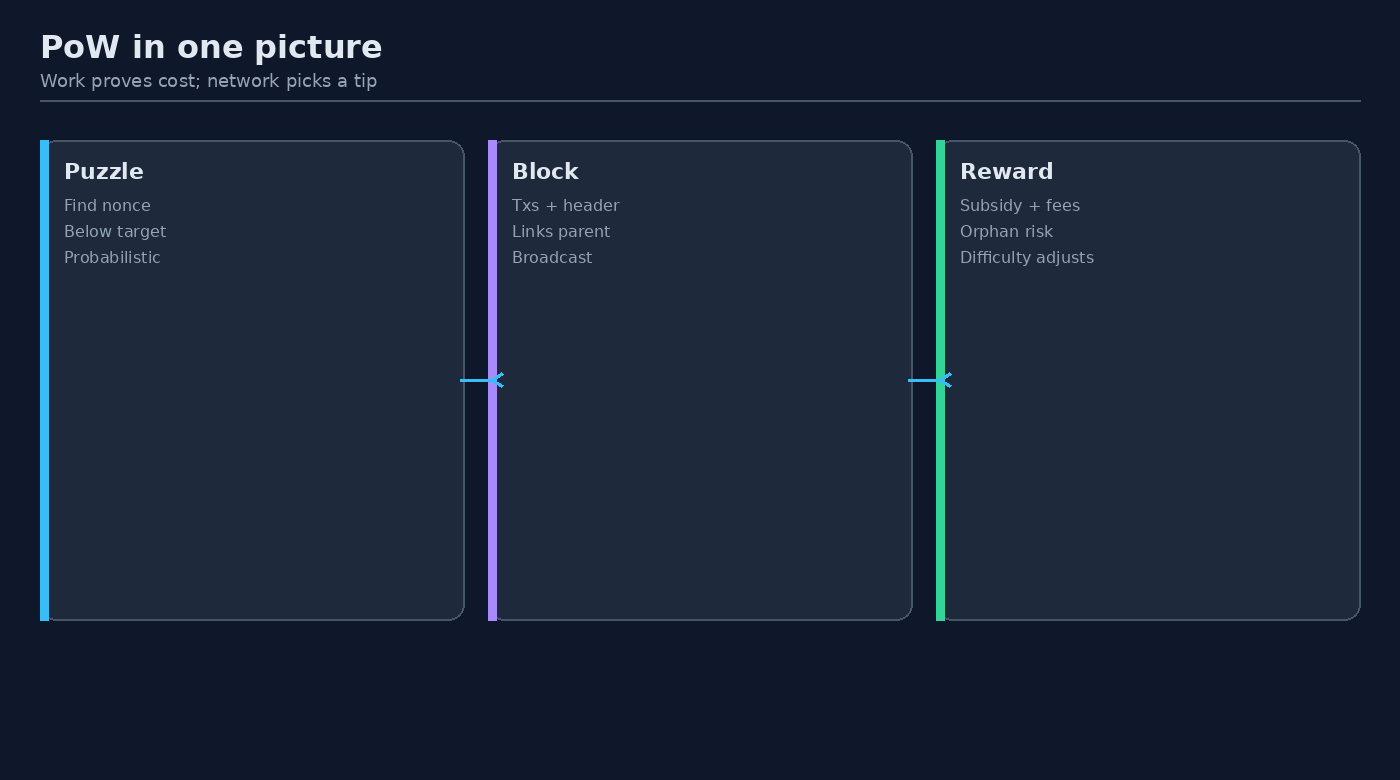
Proof of Work makes nodes compete on a verifiable puzzle; winners produce blocks and earn rewards/fees (rules vary). Mining trades energy and hardware for block rights and incentives, and makes rewriting history expensive.
Think of an open-book exam: the answer is hard to guess by chance, but easy for everyone to check. Whoever submits a valid solution first temporarily wins the right to append the next page of the ledger—and collects the rule-defined reward.
PoW is not the only consensus family (Ch. 3 covered PoS and others), but it remains the security story Bitcoin opened and many shard networks still use: attacks are expensive; verification is cheap.
Difficulty, block time, halving intuition
- Difficulty retargets so block intervals stay near a goal (Bitcoin ~10 minutes; SCDO Shard0 targets on the order of ~13s—check live chain params).
- More hashrate → higher difficulty: the same rig can earn less over time.
- Halving / reward decay: never extrapolate old screenshots into a business plan.
Miners, full nodes, pools
| Role | Job | Cost / risk |
|---|---|---|
| Full / bookkeeping node | Hold state, verify, may produce blocks | Disk, bandwidth, ops |
| Miner | Search PoW solutions at target difficulty | Power, hardware wear, heat/noise |
| Pool | Aggregate hashrate; pay by shares | Fees, rules, centralization |
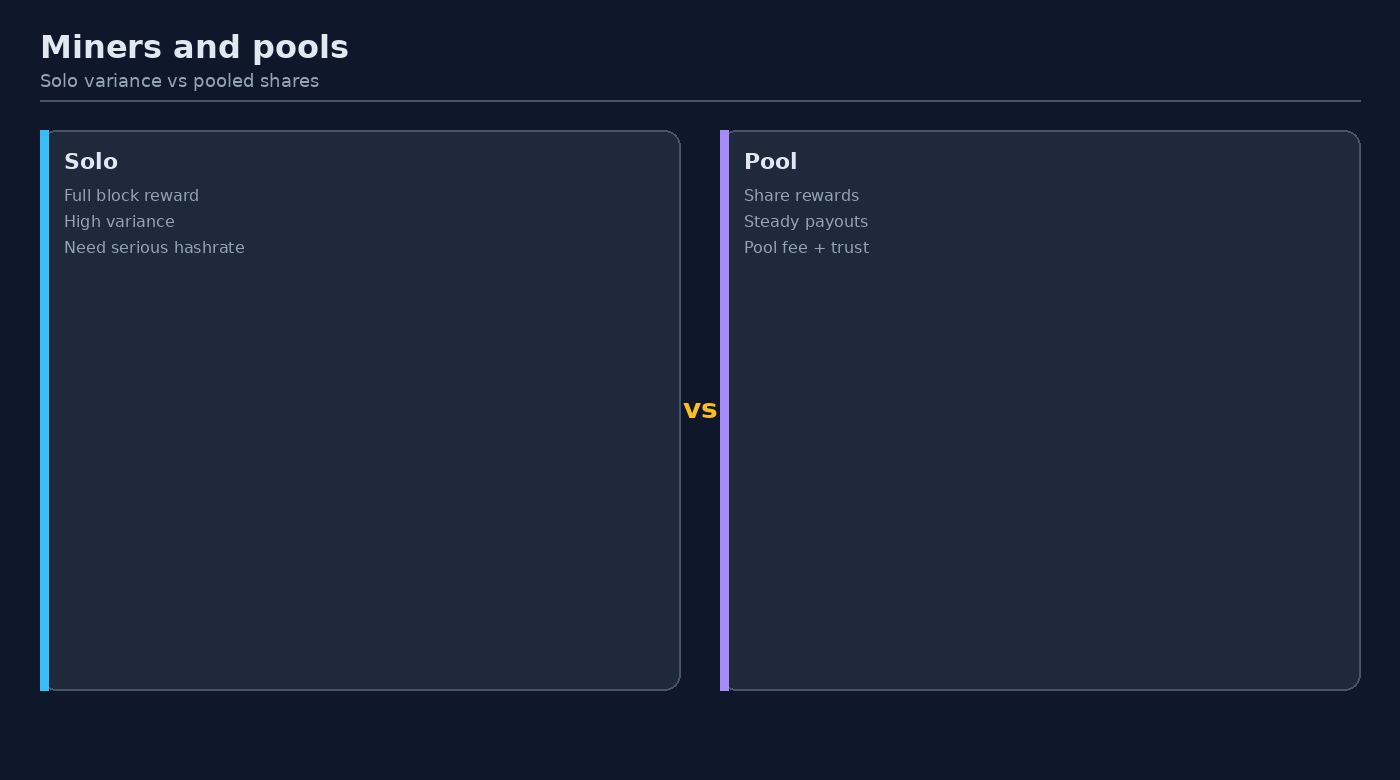
Pools cut luck volatility and add centralization and rule trust—check fees, payouts, switchability, history, algorithm support, and address formats.
Reading hashrate share
If public materials show large project-operated hashrate, treat that as a decentralization risk indicator, not instant conspiracy. Independent bookkeepers, verifiable software, and transparent rules help. Education: treat distribution as a health check, not a “house always wins” ad.
GPU, CPU, ASIC
- CPU: flexible; some scientific-style algorithms.
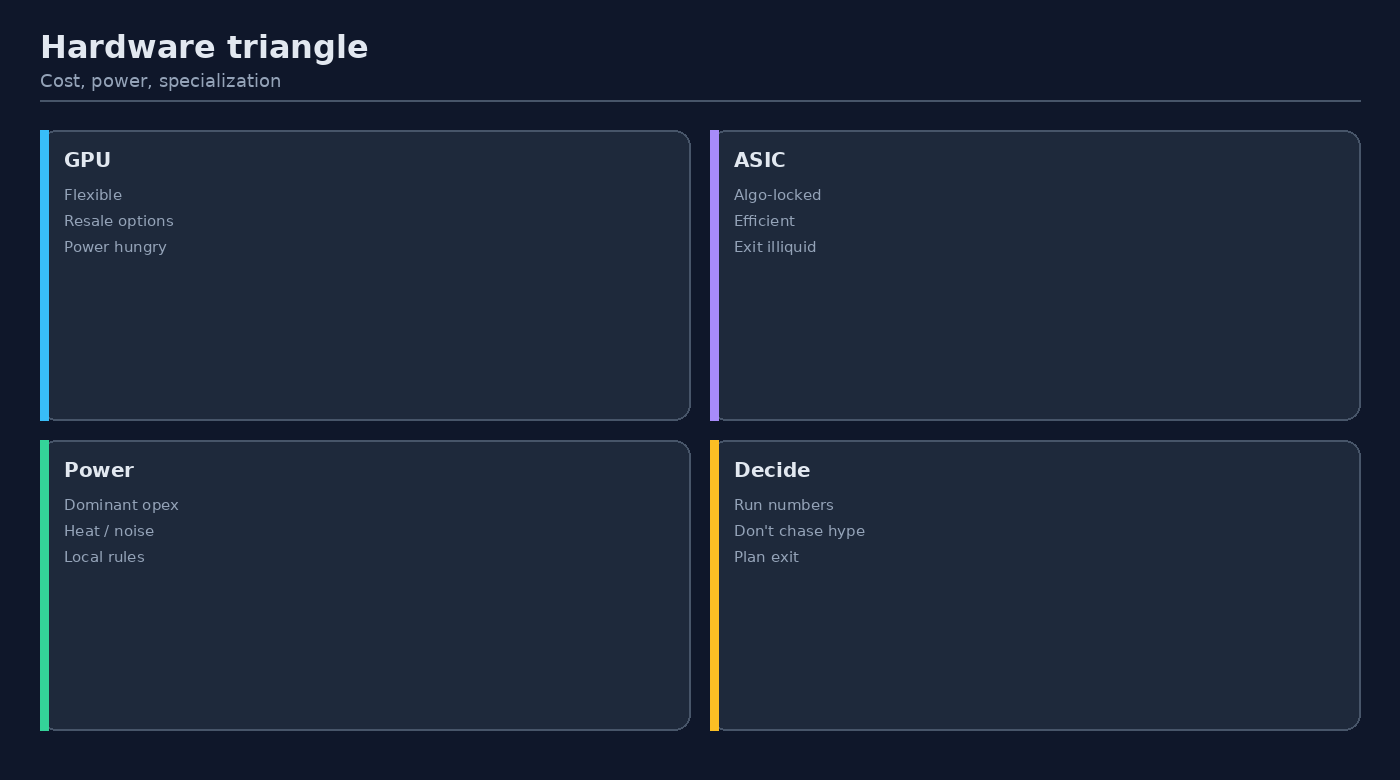
- GPU: workhorse for Ethash-family and many PoWs.
- ASIC: algorithm-specific efficiency; prices out casual hardware.
Algorithm choice shapes who can mine: ZPoW vs Ethash imply different hardware ecosystems. Before buying cards ask: which chain, which algorithm, which official miner builds?
Power, cooling, premises
- Price local kWh honestly.
- Noise and leases can forbid mining outright.
- Fans, PSUs, and GPUs are consumables.
- Verify miner software hashes; avoid “cracked optimizers.”
Costs, risks, honest expectations
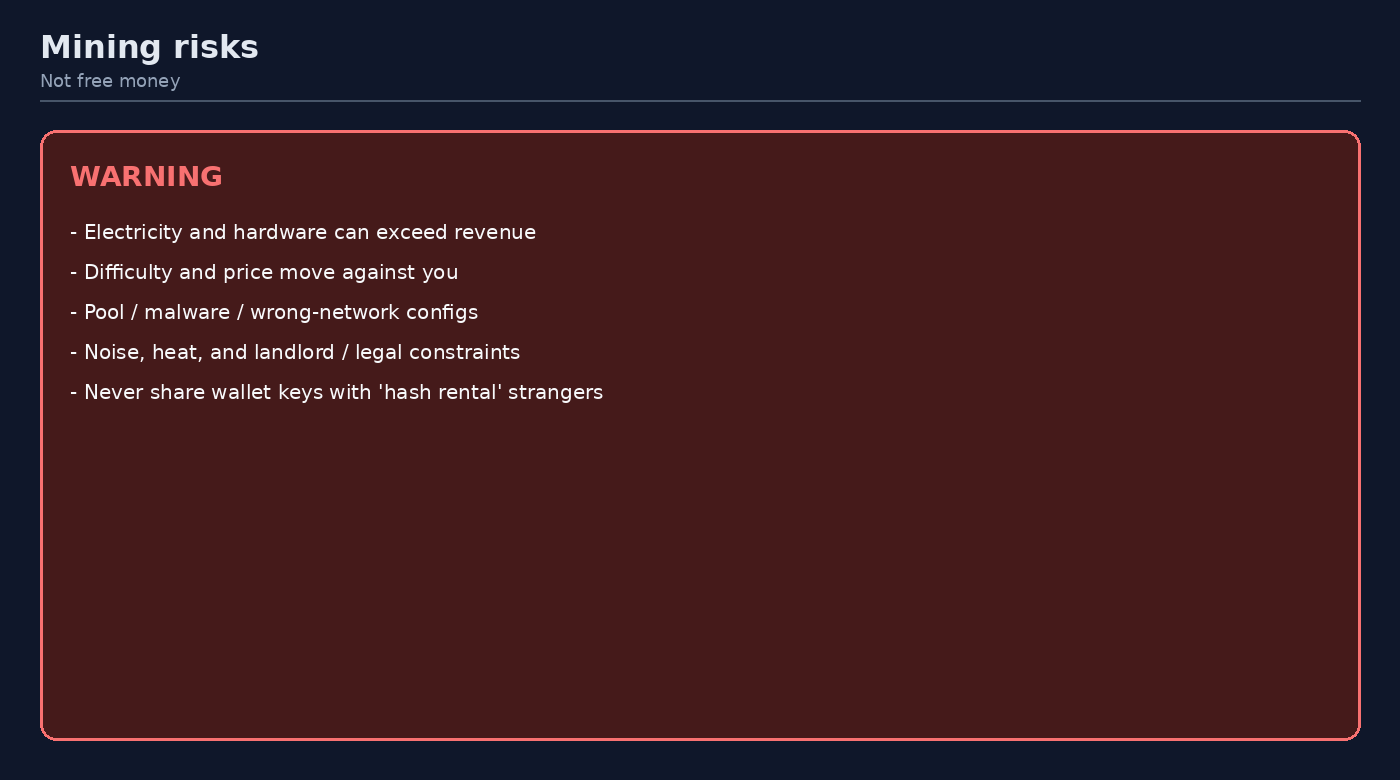
Losses happen. Price, difficulty, pool fees, and resale value can erase margins. Policy varies by place. This book offers no guaranteed rig list and does not teach how to evade energy or tax rules.
SCDO track A: Shard0 Ethash
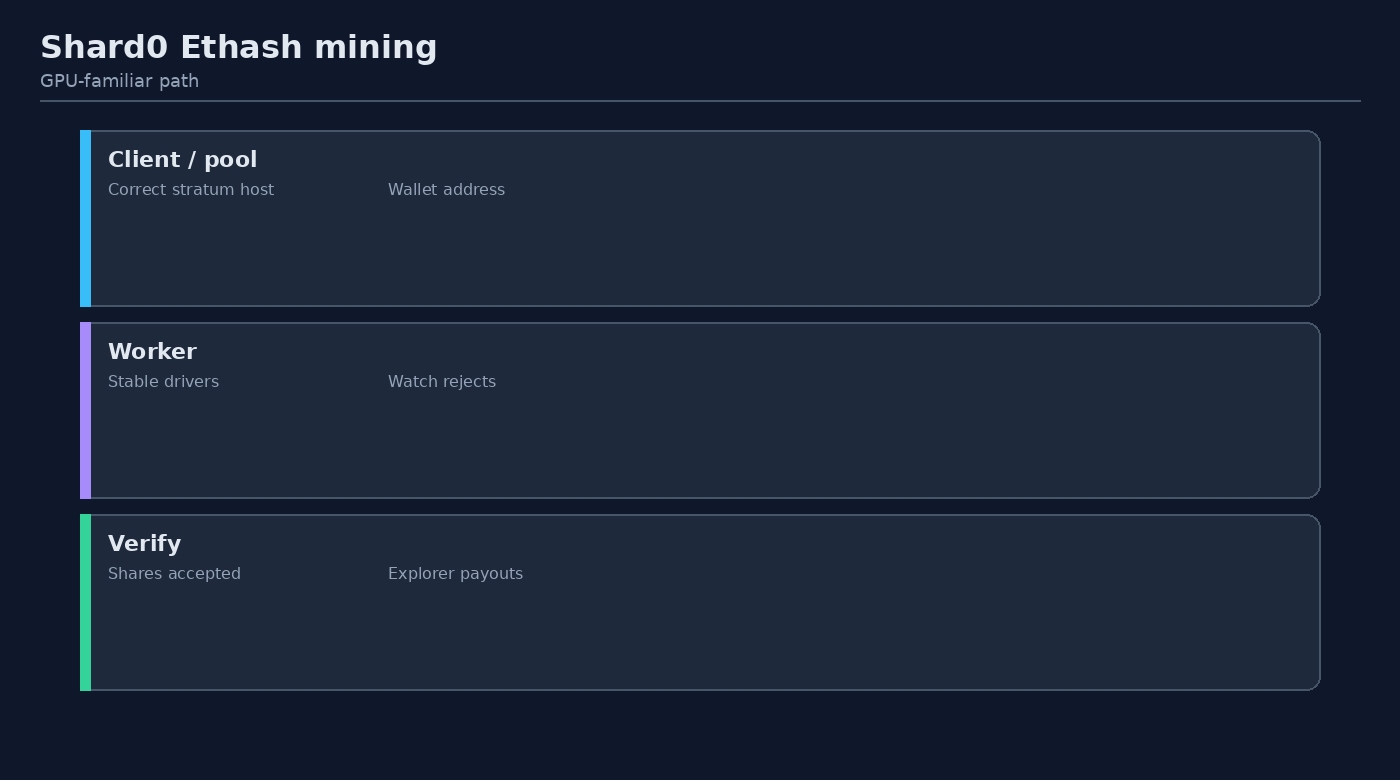
- Shard0 EVM · Ethash · chainId 5680.
- Tooling resembles Ethereum-PoW-era GPU stacks; follow official guides.
- Addresses are
0x…; payouts must match EVM wallets. - Project hashrate may be large—independent bookkeepers help (per disclosure).
Suggested order: read docs → confirm address format → small hashrate trial → scale.
SCDO track B: Classic Shards 1–4 ZPoW
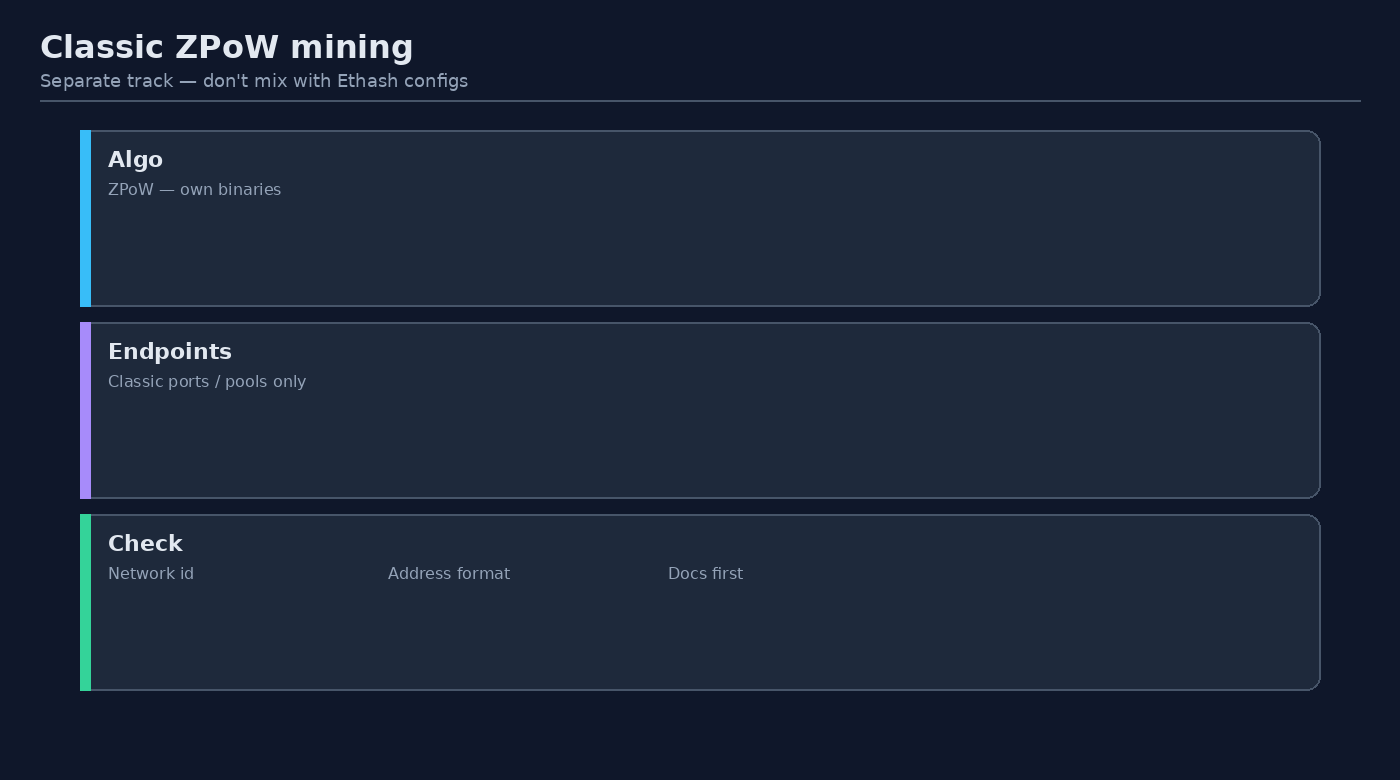
- Four Classic shards; ZPoW consensus.
- Address/wallet paths differ (
1S…vs0x…). - GPUs common; wallet CPU bookkeeping may exist—per then-current docs.
- Know which shard your payout address lives on.
Two-track cheat sheet
| Item | Shard0 | Classic S1–4 |
|---|---|---|
| Consensus | Ethash PoW | ZPoW |
| Tooling intuition | Ethereum-like GPU/EVM | go-scdo ecosystem |
| Address | 0x… |
1S… |
| Agent Ledger | Contract anchoring home | Core shard value transfer |
| First question | Is chainId 5680? | Is the address Classic? |
Pool terms: five things to read
- Fee %. 2. Minimum payout and schedule. 3. Algorithm and stratum ports. 4. Payout asset and address format. 5. Operator history and governance.
Security side channels
Mine on machines that do not hold exchange sessions or large seed phrases. Lock down remote admin. Electrical safety is personal safety, not only asset safety.
Newcomer checklist
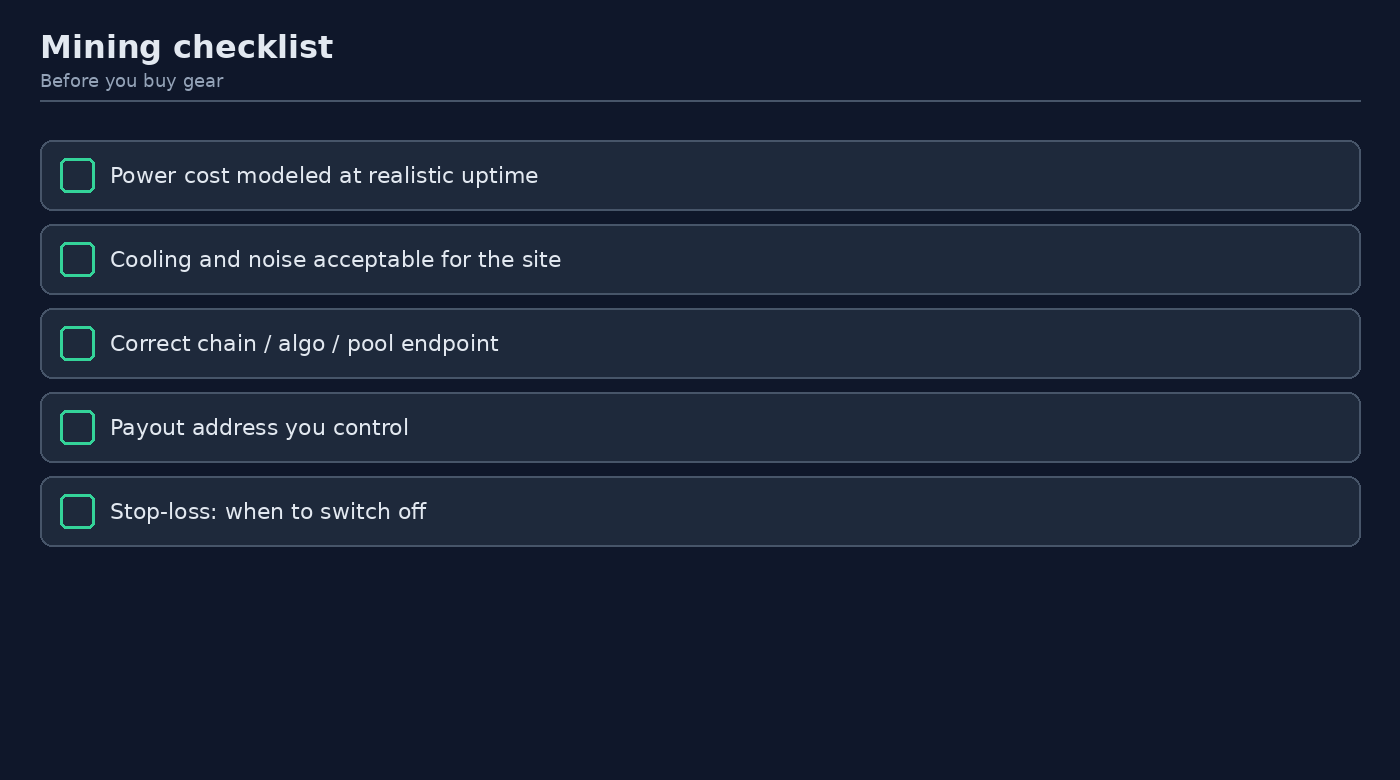
- Know chain and algorithm.
- Price power and noise; ignore hype screenshots.
- Triple-check payout addresses; use trusted pools.
- Verify miner software hashes.
- Separate experiment rigs from savings wallets.
- Watch public hashrate disclosure and rule changes.
- Obey local law and lease/grid constraints.
Relation to agents and payments
Mining earns block rewards/fees; Agent Ledger records agent work and settlement receipts. Do not merge “mining dashboard” and “agent heartbeat” into one product story.
Chapter wrap
PoW = verifiable compute race; pools trade variance for trust points; hardware follows algorithms. SCDO: Shard0 Ethash EVM track + Classic S1–4 ZPoW shard track. Next: bots and payments.
(Chapter 11 · Mining · SCDO Lab · expanded 2026-10-30)