SCDO Laboratory · TECH PR
UNIT 13
Series · Automated Contract Ledgers for AI Agents · Next-Gen Smart Payments
Smart Payments: x402 & Micropayment Nests
Protocol intuition for next-gen smart payments · Author Ying Willam Zhang
13. Payments: on-chain pay, stablecoins, x402, SCDO settle shell
SCDO Lab · Automated Contract Ledgers for AI Agents · subtitle Next-Gen Smart Payments · ZH (Traditional):
13-payments.md
Education only — not investment, legal, or tax advice.
Learning goals
- List which fields make “I paid” verifiable on-chain.
- Name major stablecoin risks (reserves/depeg, freezes, contracts, issuer policy).
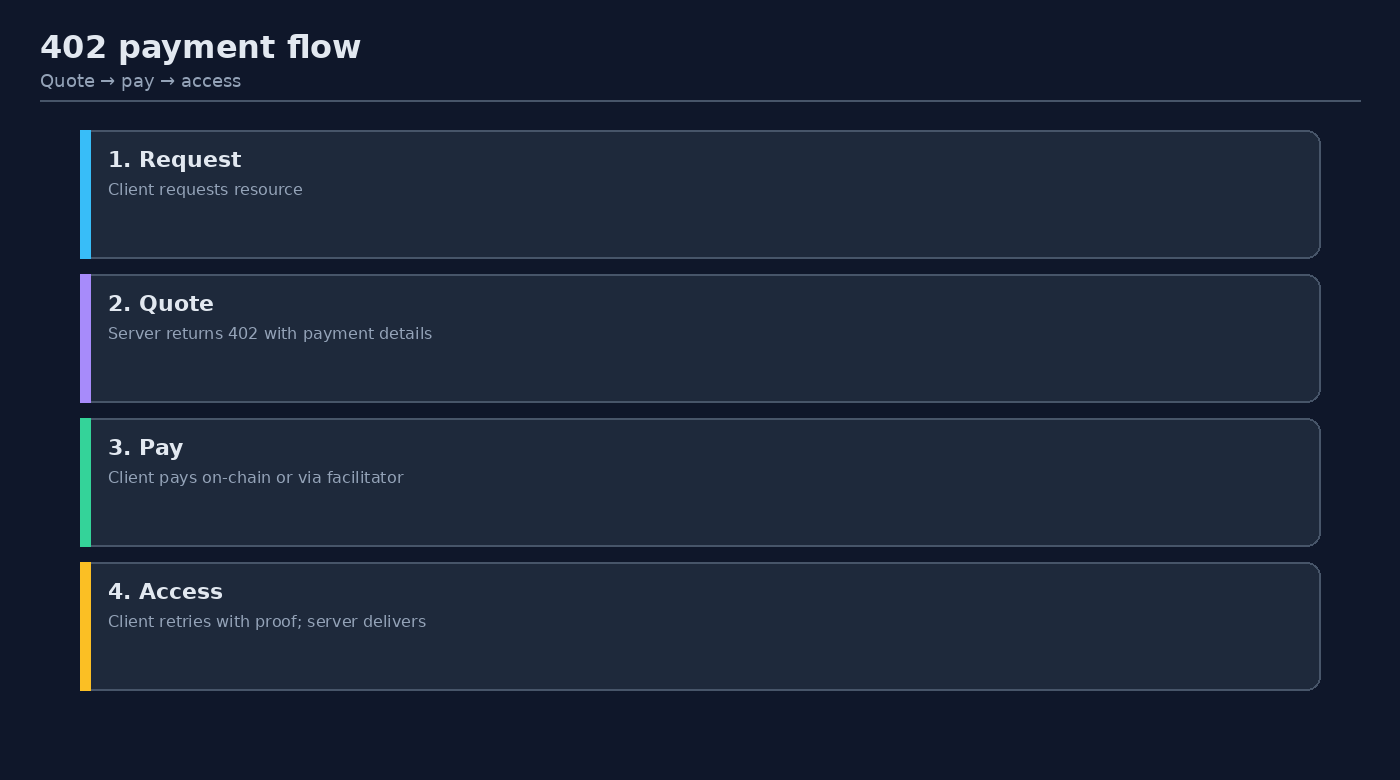
- Sketch the 402/x402 request → pay → retry loop.
- Explain settle shell and ~1¢ nest as cost intuition, not a return promise.
- Show how each CEX/DEX/bridge hop adds a trust assumption; read compliance locally.
What on-chain pay solves — problem definition
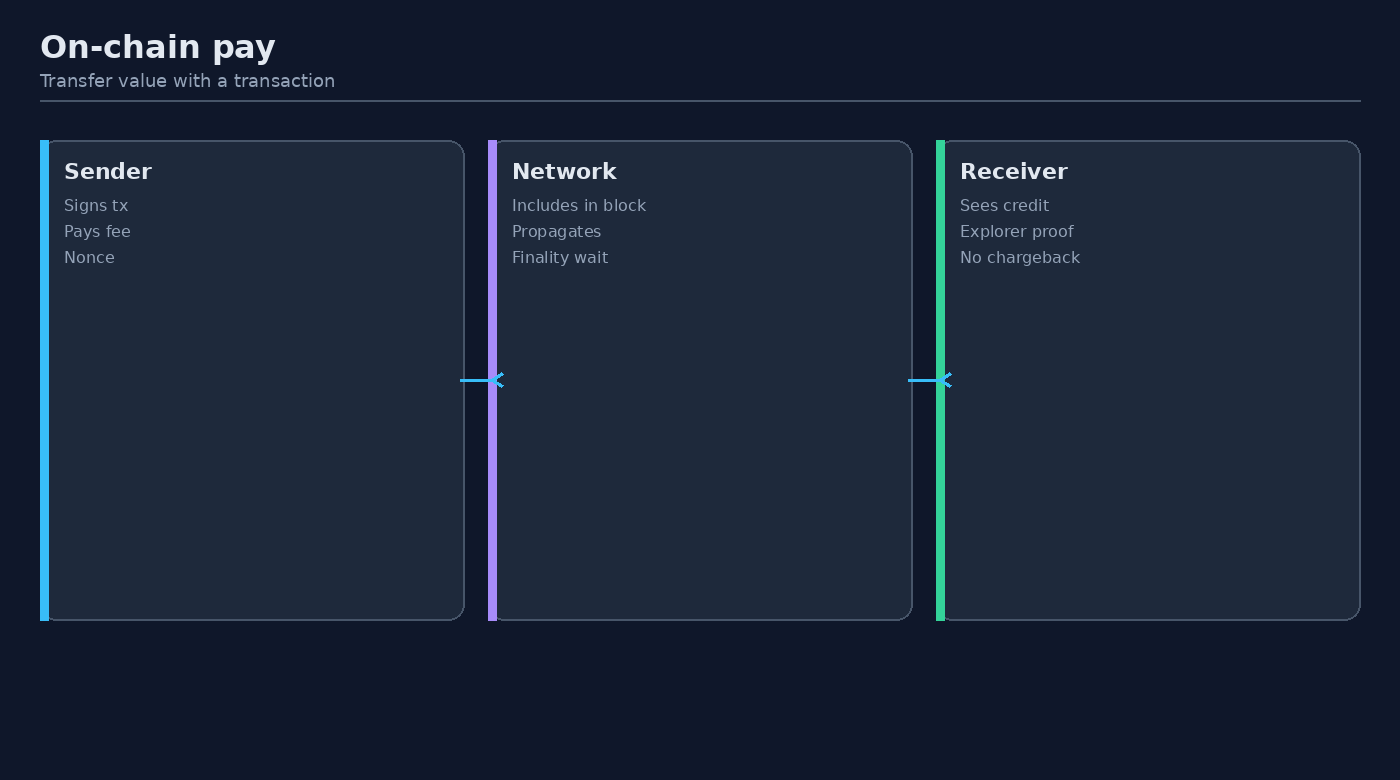
Traditional rails depend on accounts and clearing institutions: convenient for humans, often awkward for high-frequency machine micros (fees, delays, manual review). The educational promise of on-chain pay is turning “I paid” into a verifiable state change: amount, asset, payee, time, transaction hash.
Good for programmatic settlement; not a claim of perfect anonymity or zero regulation. Public-ledger transfers are often more traceable than cash.
What you are actually verifying
| Field | Why it matters |
|---|---|
| Asset and amount | Wrong asset/decimals = incident |
| Payee | One-character address errors can be irreversible |
| Time / height | Reconciliation and dispute windows |
| Tx hash | External “paid” receipt hook |
| Network | Wrong chain is a common disaster |
Stablecoins: unit of account and risk
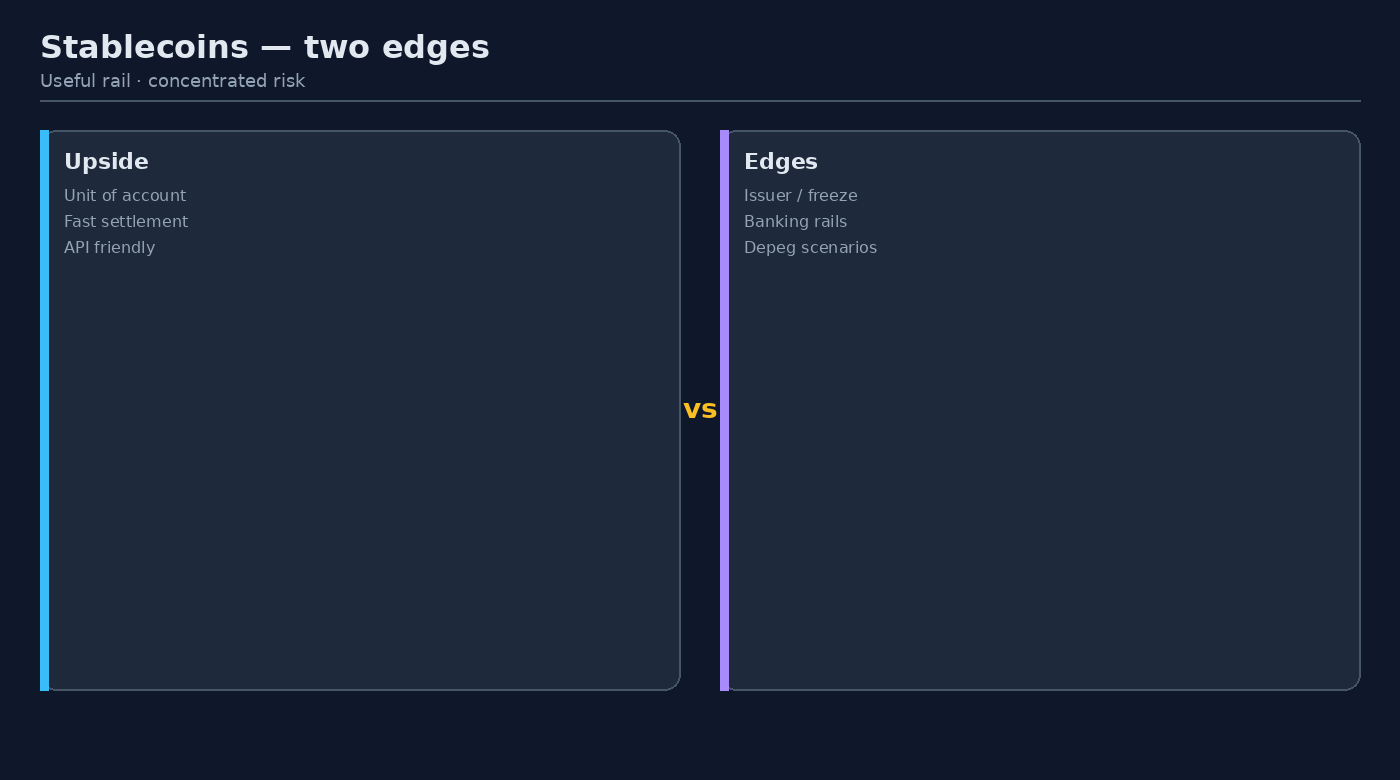
Stablecoins price machine commerce near fiat units so every API call need not quote a volatile coin. Risks include reserves/depeg, freeze lists, contract bugs, issuer policy/jurisdiction shifts, and bridge/wrapped-asset counterparties.
Treat as a tool, not risk-free cash. SCDO-related pilots often mention USDC on Base for agent per-call paths—early stage may change; follow official docs.
x402 / HTTP 402 payment shell
Per-call unlock: request → 402 → pay → retry. SCDO-related practice wires micro stablecoins into agent calls; follow live pilot docs.
Versus subscriptions (intuition)
| Monthly subscription | 402 per-call | |
|---|---|---|
| Fits | Human products, steady usage | Machine spikes, high frequency |
| Failure mode | Pay for idle capacity | Every call crosses a pay gate—control latency and caps |
| Reconciliation | Billing cycle | Per-tx hash/receipt |
If public materials mention fee splits on lab paths, read them as disclosure of an operational choice, not an invitation that you will earn the same cut. Early mainnet external paying customers may be none—read trust pages literally.
SCDO settle shell and ~1¢ nest
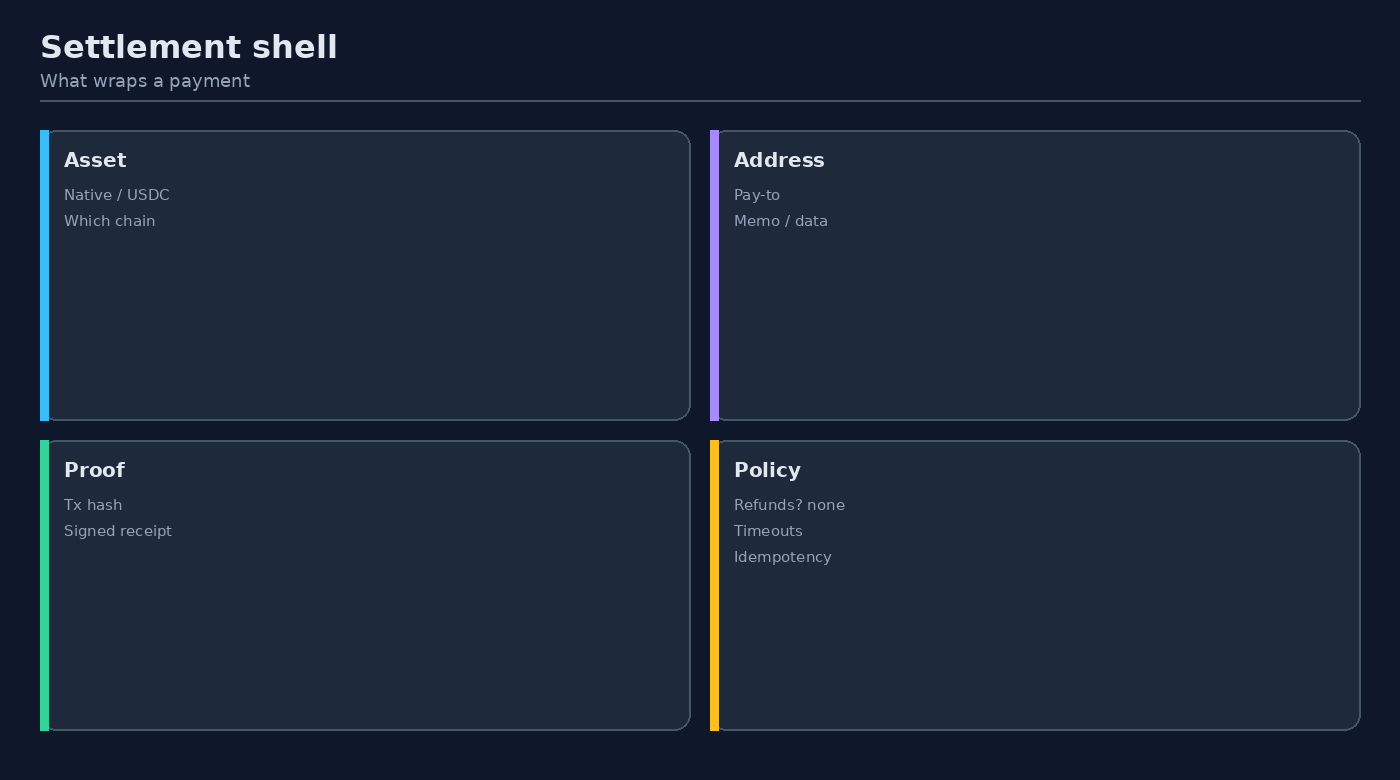
Settle shell = thin layer around ledger and pay routes: caps, receipts, anchors, reject-unpaid. ~$0.01 nest is cost intuition—smart payments must support high-frequency micros, not only large wires.
It connects to Chapter 12 nests and Agent Ledger: identity/heartbeats first, payment shell second. Payment automation without a control plane only accelerates mistakes.
Mini case (teaching fiction)
A data API prices about 1¢ USDC per agent call. Developers set daily caps, allowed paths, and retry limits in the shell. The first successful call leaves a checkable receipt; unpaid calls stay 402. Week one optimizes latency and false rejects, not vanity volume.
Relation to CEX / DEX
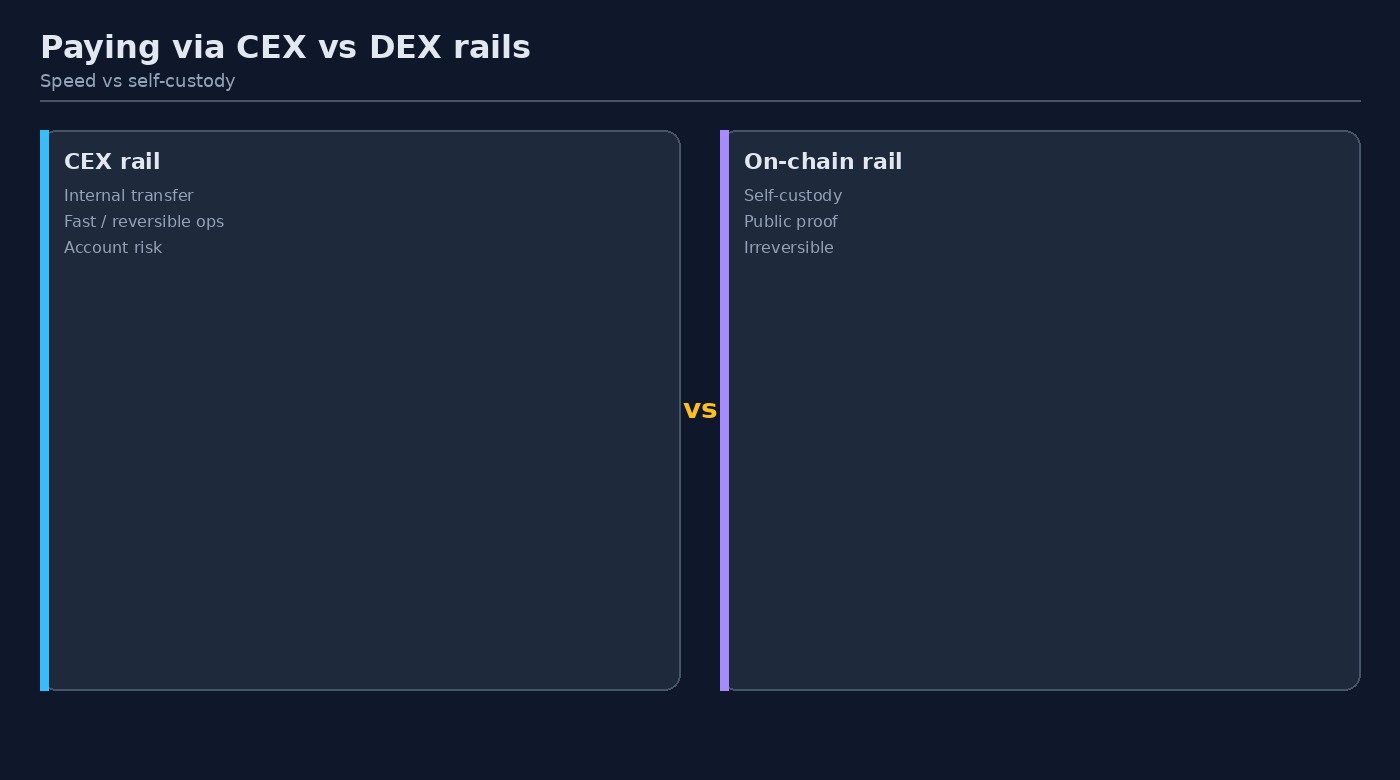
Fiat on/off often via CEX; on-chain swaps via DEX/AMM (Ch. 5). Agent pay layers reduce clicks but may still depend on issuers and bridges—each hop adds trust assumptions.
Reading list: where money enters/exits; how many custodians/bridges; which steps can pause/freeze/upgrade; which hashes you can show after an incident.
Compliance (high level)
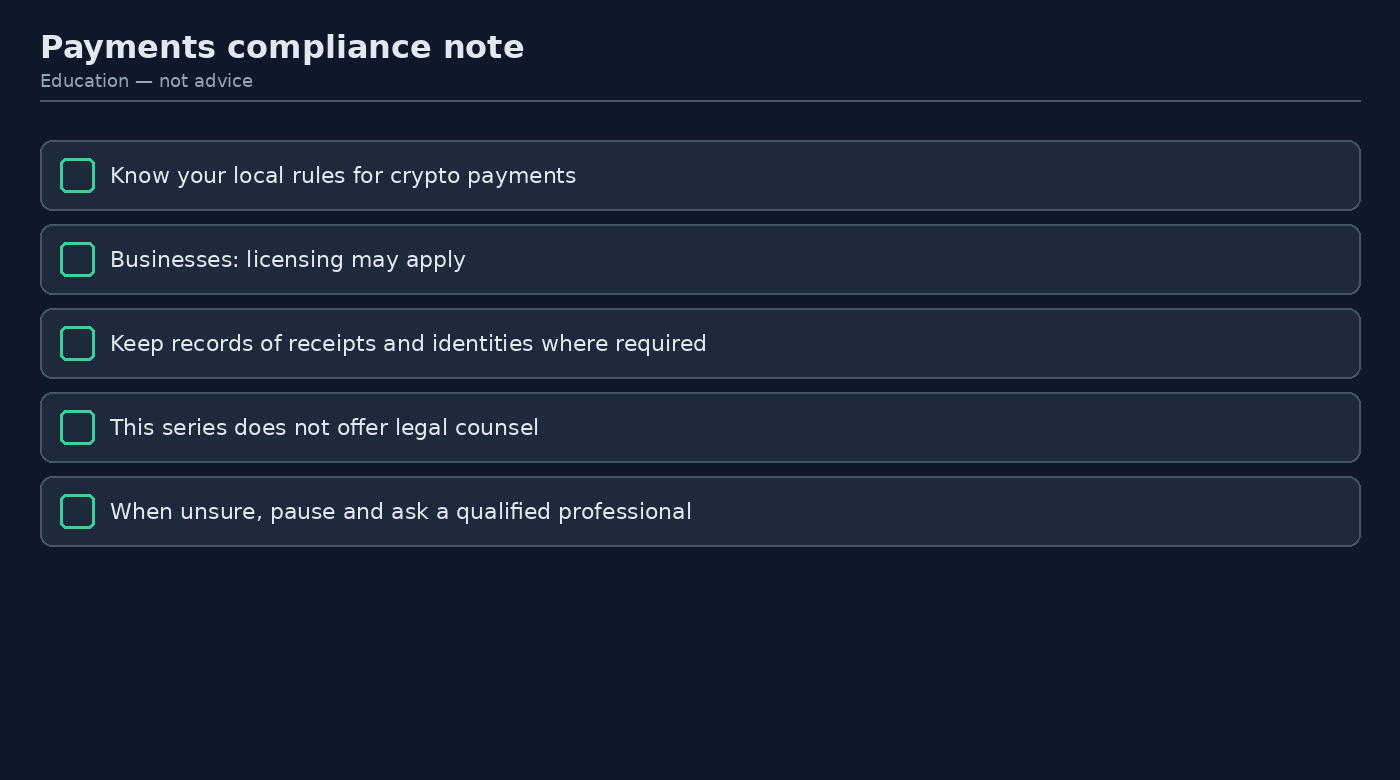
Cross-border pay/exchange may trigger local licensing and reporting. In AU context, read operator AUSTRAC DCE / AFCA disclosures (Ch. 10)—registration ≠ endorsement. This book does not teach evasion.
Real user funds also raise consumer-protection and regulated-activity questions beyond this primer—seek professional legal advice (not provided here).
Short quiz
- Which fields should an on-chain pay receipt let you check?
- Name four stablecoin risk themes.
- What does a settle shell mainly block?
- Why does one more bridge hop add trust assumptions?
Sketch: (1) Asset/amount, payee, network, time, hash, etc. (2) Depeg, freezes, contracts, issuer policy. (3) Unpaid/over-cap/uncontrolled automation. (4) Another failure/malice/upgrade surface.
Takeaways
- Next-gen smart payments = stablecoin pricing + 402 per-call gates + verifiable ledger shell + honest risk disclosure.
- ~1¢ is cost intuition, not a return promise.
- CEX/DEX/bridges all add friction and trust points.
- Education only — not investment advice.
Chapter wrap
Next: provable fairness and gambling-tech red lines (educational, no funnels).
(Chapter 13 · Payments · SCDO Lab)
Learning goals (addendum)
After this chapter you should: (1) distinguish on-chain state change from in-app balances in one sentence; (2) list the four stablecoin questions; (3) draw the 402 happy path with an idempotency key; (4) explain why a local exchange registration is not a global payments licence; (5) log both human-readable amounts and atomic integers.
Minimum test matrix for wallet/agent builders
- Correct-decimal transfers including min unit.
- Expired quotes rejected.
- Idempotent replay does not double-charge.
- Non-allowlisted payees rejected.
- After human kill-switch, new requests fail with explainable codes.
Copy bans (re-emphasized)
Do not claim on-chain pay “cannot be frozen,” “needs no compliance,” or treat testnet screenshots as mainnet volume. Do not imply one jurisdiction’s exchange registration is a worldwide payments licence.
Key takeaways
On-chain pay wins on verifiability and programmability—not absolute anonymity. Stablecoins price machine commerce and carry issuer/contract risk. x402 fits per-call unlocks; engineering centers on quotes, idempotency, receipts, timeouts. SCDO settle shells / ~1¢ nests constrain high-frequency micropay feasibility—not consumer casino products.